
← Back to blog6 min read
Claude Opus 5.5 is Anthropic's newest Opus model, released on September 22, 2026. It scores higher than Claude Fable 5.1 on every row of Anthropic's launch table, costs about 40% less per task than Opus 5, and writes its output more than 30% faster. In Claude Code your 5 hour limit went up too, and Pro, Max and Team users got a usage reset they can save for later. The one thing worth doing before you lean on it: run a prompt audit, because Opus 5.5 behaves differently from Opus 5 and old instructions can quietly work against it. This post covers the scores, the price, the new limits, and what the audit changed on my own setup.
Short on time? Jump to the 1 command to run.
The AI space moves weekly, so every price, limit and score below is current at the time of writing and linked to its source.
Key Takeaways
- Claude Opus 5.5 scores higher than Fable 5.1 on all 9 rows of Anthropic's launch table, and has the top score of any model on 7 of them.
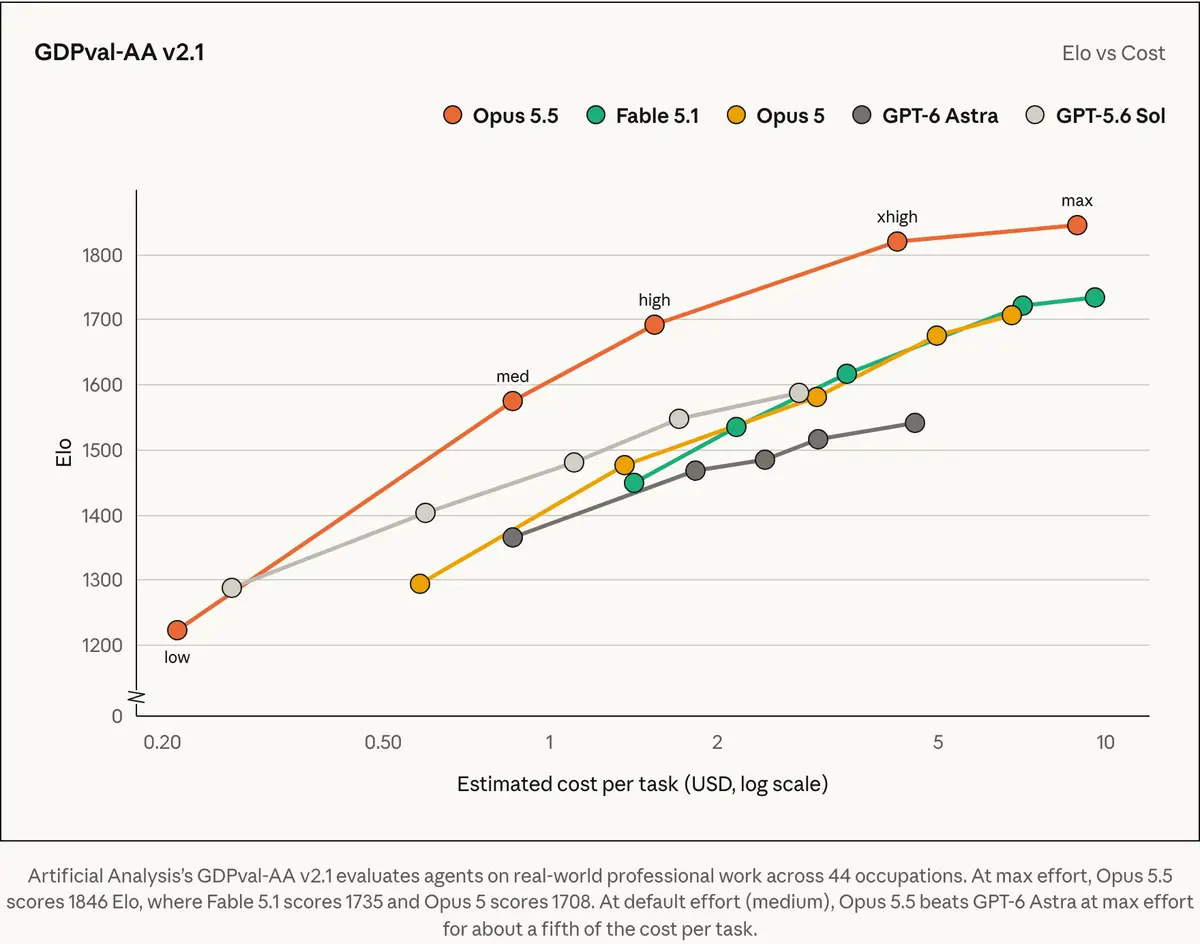
- On real office work it scores 1846 against 1735 for Fable 5.1.
- It costs $4 per million input tokens and $20 per million output tokens, down from $5 and $25 on Opus 5.
- In Claude Code, 5 hour limits rose 20%, and Opus 5.5 goes 25% further within them.
- Before you move old prompts over, run a prompt audit in Claude Code. On my setup it made 22 fixes across 4 areas, and nothing broke.
What Is Claude Opus 5.5?
Claude Opus 5.5 is Anthropic's newest Opus model, the follow up to Opus 5. It is available on the Claude API as claude-opus-5-5 on the major cloud platforms, and in Claude Code. The headline from Anthropic's Claude developer account is that Opus 5.5 "performs at the level of Fable 5.1" while costing less than Opus 5. If you read my Claude Opus 5 breakdown, this is the same family, a step up in quality and a step down in price.
Three things change for you in practice: it is smarter and cheaper, you get more usage, and its answers are easier to read.
Claude Opus 5.5 vs Fable 5.1: Does It Really Beat Fable?
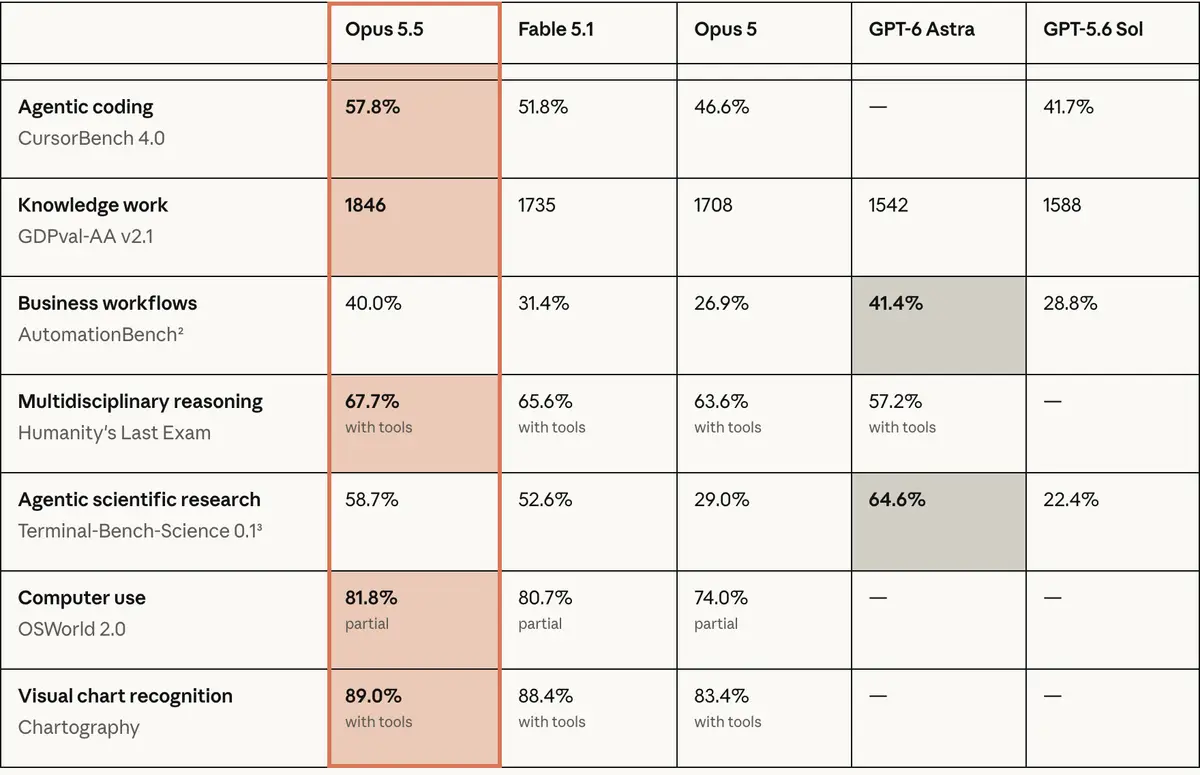
Yes, on Anthropic's own table. In the Opus 5.5 announcement, Opus 5.5 posts a higher score than Fable 5.1 on all 9 benchmark rows, run at max effort unless noted.
| Benchmark | Opus 5.5 | Fable 5.1 |
|---|---|---|
| Knowledge work (GDPval AA) | 1846 | 1735 |
| Agentic coding (CursorBench 4.0) | 57.8% | 51.8% |
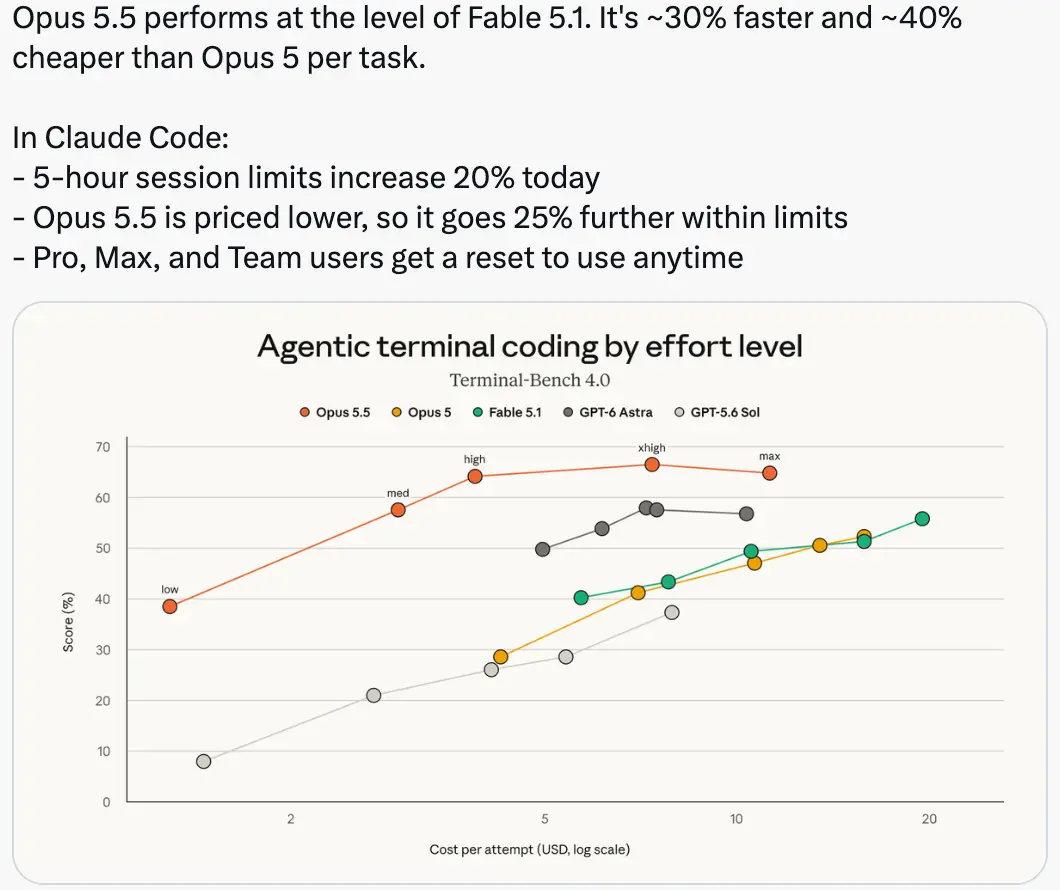
| Terminal coding (Terminal Bench 4.0) | 66.4% | 55.8% |
| Computer use (OSWorld) | 81.8% | 80.7% |
| Humanity's Last Exam, with tools | 67.7% | 65.6% |
Some gaps are small: computer use and chart reading are within about a point. The widest gap in points is terminal coding, 66.4% against 55.8%. Knowledge work, the benchmark built from real tasks across 44 occupations, shows 1846 against 1735.
Where does GPT-6 Astra still win?
GPT-6 Astra takes 2 rows: business workflows (AutomationBench, 41.4% against 40.0%) and agentic scientific research (Terminal Bench Science, 64.6% against 58.7%). The first gap is close enough to call a tie. The second is real, so for science research work Astra is still the stronger pick.
Does Opus 5.5 need max effort to win?
No. On the knowledge work chart, Opus 5.5 at medium effort scores above GPT-6 Astra at max effort, for about a fifth of the cost. Effort is the setting that controls how long the model thinks before it answers, and I compare it with switching models in effort vs model.
Claude Opus 5.5 Price: How Much Cheaper Is It Than Opus 5?
Opus 5.5 costs about 40% less than Opus 5 per task, per Anthropic. Its per token price is lower, and Anthropic says it tends to finish the same task with fewer tokens.
| Price per million tokens | Opus 5.5 | Opus 5 |
|---|---|---|
| Input | $4 | $5 |
| Output | $20 | $25 |
Those are the API rates listed in what's new in Opus 5.5 at the time of writing. Most people reading this pay a fixed subscription instead, and on a subscription the lower price shows up somewhere more useful: your limit lasts longer.
Opus 5.5 Usage Limits in Claude Code
How much did the 5 hour limit go up?
In Claude Code, 5 hour session limits went up 20% on launch day, and because Opus 5.5 is priced lower, it goes 25% further within those limits. Those are 2 separate gains: a bigger limit, and a model that spends less of it per task.
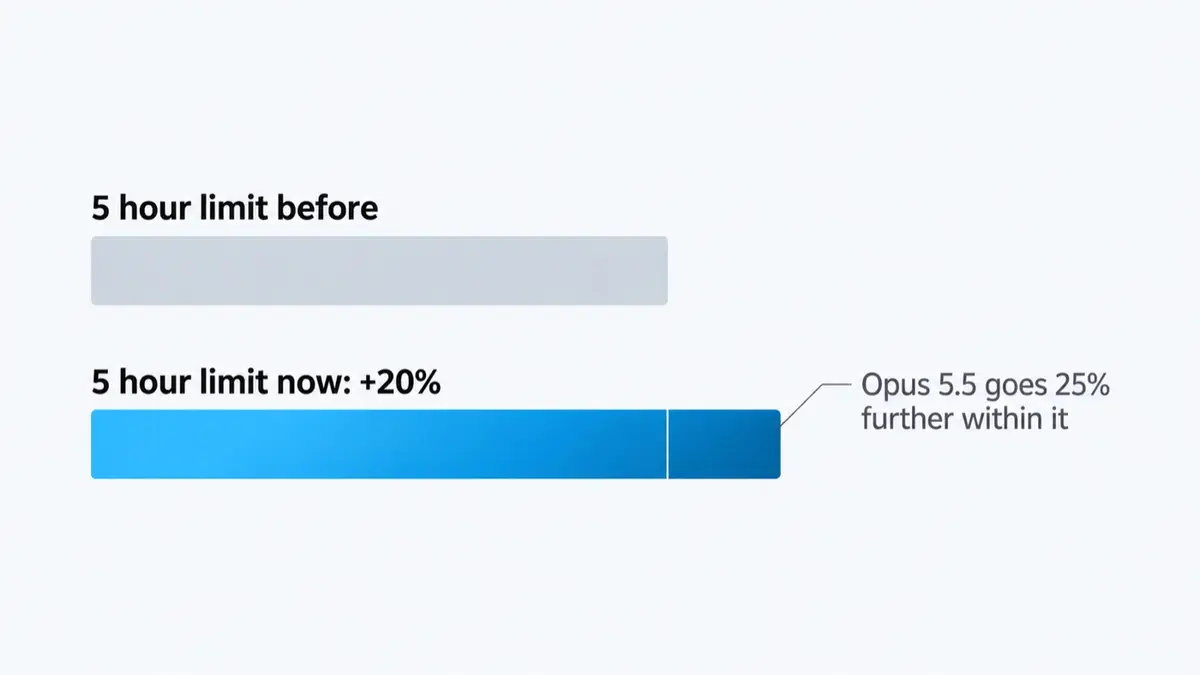
Both figures come from the launch post by Anthropic's Claude developer account, below. Anthropic's announcement confirms the higher limits on Pro, Max, Team and seat based Enterprise plans.
What is the saved usage reset?
Pro, Max and Team users got 1 usage reset they can save and use whenever they choose. It is worth keeping for the day you hit your limit in the middle of real work. On my account, the usage page showed it expiring about a month after launch, so check yours under Settings, then Usage, before it lapses. If you want to know how far a plan stretches in the first place, I broke down the Max 20x limits separately.
Are Opus 5.5 Answers Easier to Read?
Yes. Anthropic says Opus 5.5 puts the most important information up front and is less likely to use jargon. Here is the same question, "Please explain the issue to me", asked of both models.
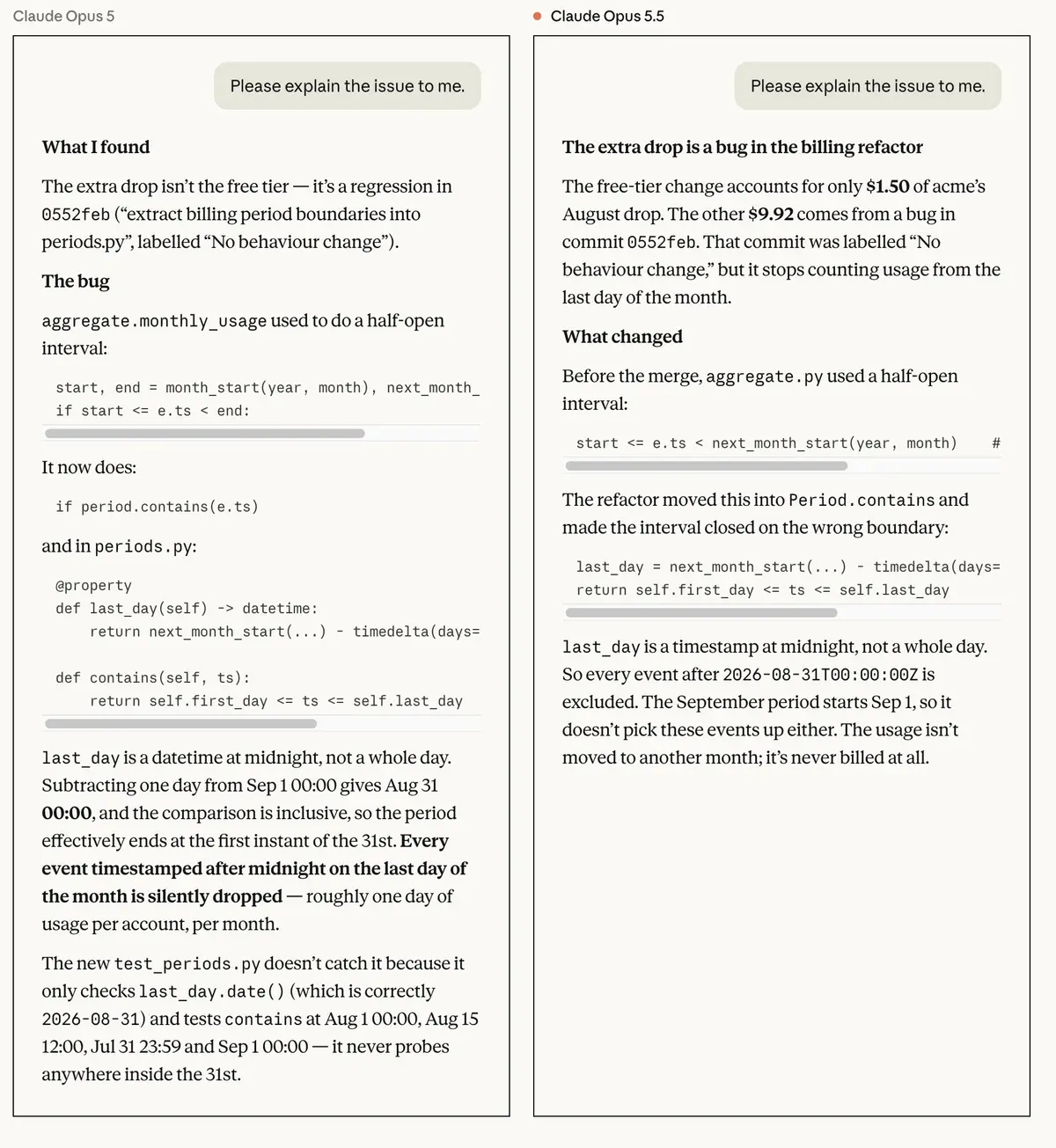
Opus 5 walks through the code first and reaches the point near the end. Opus 5.5 leads with the answer: the free tier change explains $1.50 of the drop, and the other $9.92 comes from one commit. For anyone who reads AI output to make a decision, that ordering saves the most time.
The 1 Command to Run: a Prompt Audit
Run a prompt audit in Claude Code before you move your prompts, skills and instruction files over to Opus 5.5. Anthropic says existing Opus 5 prompts should perform well without changes, but it lists behavior differences worth checking, and on my setup the audit still found plenty to fix.
What changed that can break old prompts?
A few defaults moved, and these hit anyone with code that calls the model through the API:
| What changed | Opus 5 | Opus 5.5 |
|---|---|---|
| Default effort | high | medium |
| Turning thinking off | allowed | returns an error |
| Forcing a specific tool call | allowed | returns an error |
Instruction files have their own version of the problem. On my setup, the audit rewrote lines written in capitals to push an older model harder, along with rules that no longer matched how the projects work. My Opus 5 prompting notes cover why deleting instructions often helps more than adding them.
How do you run a prompt audit in Claude Code?
Open Claude Code in your project folder and type:
/claude-api prompt-audit
The /claude-api skill comes bundled with Claude Code, and it reads whatever you type after the command as the request. This is the one I ran, and it works on a subscription plan too. Typing it asks the skill, in plain words, to audit your prompts. On my run it scanned my prompts, skills and the code that calls the model, reported what was out of date, and fixed it.
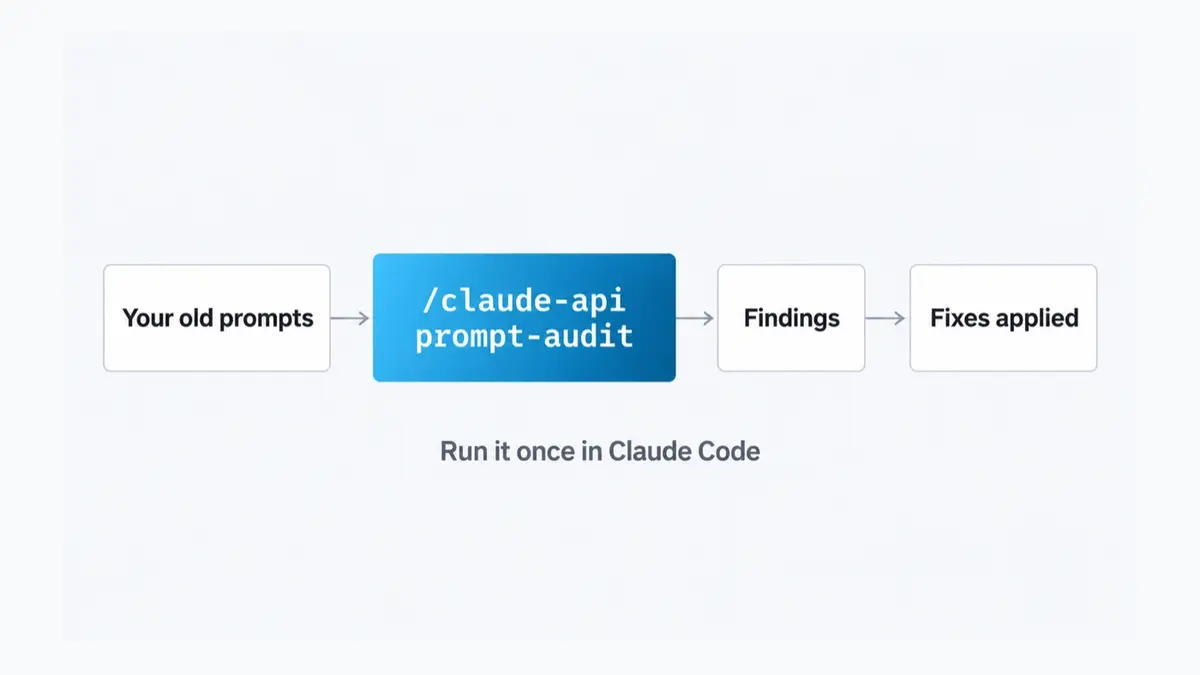
If your project mostly calls the API, Anthropic also documents a dedicated migrate command in the Claude API skill. It swaps model IDs, converts thinking settings and recommends an effort level across a code base. Check forced tool calls yourself:
/claude-api migrate this project to claude-opus-5-5
What did the prompt audit find on my setup?
I ran the audit on my own setup. It updated 3 projects, checked 3 more and found them clean, and nothing broke: the tests passed the same as before.
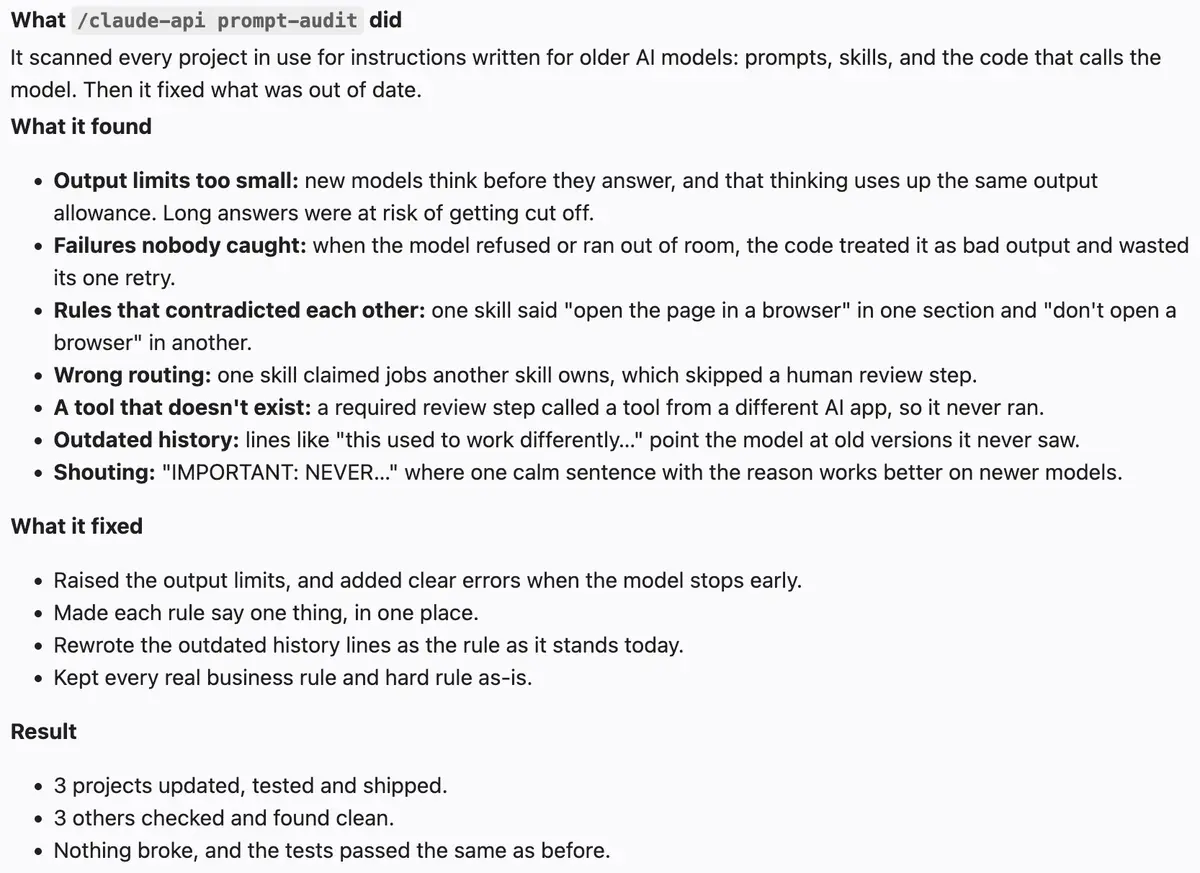
It made 22 fixes across 4 areas:
| Area | Fixes |
|---|---|
| Code that calls the model | 6, plus 2 new tests |
| Skills and instructions, first project | 5 |
| Skills and instructions, second project | 10 |
| A template | 1 |
By type, 7 were code and reliability fixes like larger output limits, 5 were rules that contradicted each other, 4 were wrong facts such as a tool that does not exist, and 6 were outdated or shouty lines rewritten. One of the contradictions: one file told the model to open a browser, and another told it not to.
What to do after the audit
Pick the right model and effort for each job. I put that into a 2 page guide: which model to use for coding, documents and computer work, which effort level to start on, and how to make your limits last. Page 1 is below.
Claude Opus 5.5 Prompting: 3 Tips From Anthropic's Guide
Anthropic's Opus 5.5 prompting guide is short, and 3 of its points apply to almost everyone:
- Start at medium effort and set it on purpose. Medium is the new default, and in Anthropic's testing Opus 5.5 at medium matches or beats Opus 5 at high on its coding and knowledge work evaluations. Test a level or two before carrying your old setting over.
- Lower effort first if it thinks too long. Thinking is always on in Opus 5.5, so effort is the dial that controls it.
- Treat a finished message as a report, not proof. On long unattended jobs, give it a checklist and name the early stops you want it to avoid.
Frequently Asked Questions
Is Claude Opus 5.5 better than Fable 5.1?
Claude Opus 5.5 scores higher than Fable 5.1 on all 9 rows of Anthropic's launch table, including knowledge work at 1846 against 1735. The gaps range from under 1 point to about 11. GPT-6 Astra still leads on 2 rows, business workflows and scientific research.
How much does Claude Opus 5.5 cost?
Claude Opus 5.5 costs $4 per million input tokens and $20 per million output tokens on the API, down from $5 and $25 for Opus 5. Per task it runs about 40% cheaper than Opus 5. On a subscription, the saving shows up as more work within your limit.
Did Claude Code limits go up with Opus 5.5?
Yes. 5 hour session limits in Claude Code went up 20% at launch, and Opus 5.5 goes 25% further within them because it is priced lower. Pro, Max and Team users also got a usage reset they can save and use later.
What is the Claude Opus 5.5 default effort?
The default effort for Claude Opus 5.5 is medium, down from high on Opus 5. Anthropic's guidance is to start there, set it explicitly, and test other levels against your own work.
Is the Claude Code prompt audit an official command?
The /claude-api skill is official and ships with Claude Code. It accepts a short request after the command, so prompt-audit is read as an ask to audit your prompts. Anthropic's documented subcommand for code bases is /claude-api migrate.