
← Back to blog6 min read
Claude Max 20x provides 20 times more usage per session than the Pro plan. Those 2 words, per session, decide almost everything about what the upgrade feels like, because Claude runs 2 separate limits and the multiplier describes one of them. There is a 5 hour session window, and there is a weekly limit sitting on top of it.
The short answer: the 5x and 20x apply to the 5 hour session window. The weekly limit is a separate cap, described without a multiplier attached to it. So the tier you pick should follow the shape of your work rather than the size of the number.
Key Takeaways
- Estimates put the weekly allowance at roughly 6 to 8 times Pro on Max 20x and 3.5 times on Max 5x. No figure is published, so take the direction rather than the decimals.
- Claude runs 2 limits at once: a 5 hour session window, and a weekly cap that is not tied to any single model.
- The 5x and 20x describe the session window. The weekly cap is set out separately.
- Your weekly reset lands on a fixed day and time assigned to your account, and it does not move if you subscribe midweek.
- On Codex the 5x and 20x describe the weekly limit instead, and the Pro tiers carry no 5 hour cap at the time of writing.
- The same number therefore means a different thing on each product: a bigger burst on Claude, a bigger week on Codex.
- On the pages linked here, neither weekly limit carries a figure, so your own usage screen is the number that describes your account.
- Concentrated bursts are what a session multiplier rewards. Work spread evenly across the week meets the weekly cap on either product.
In a hurry? Jump to the 4 checks before you upgrade. That is the part that changes the decision.
What Does Claude Max 20x Actually Multiply?
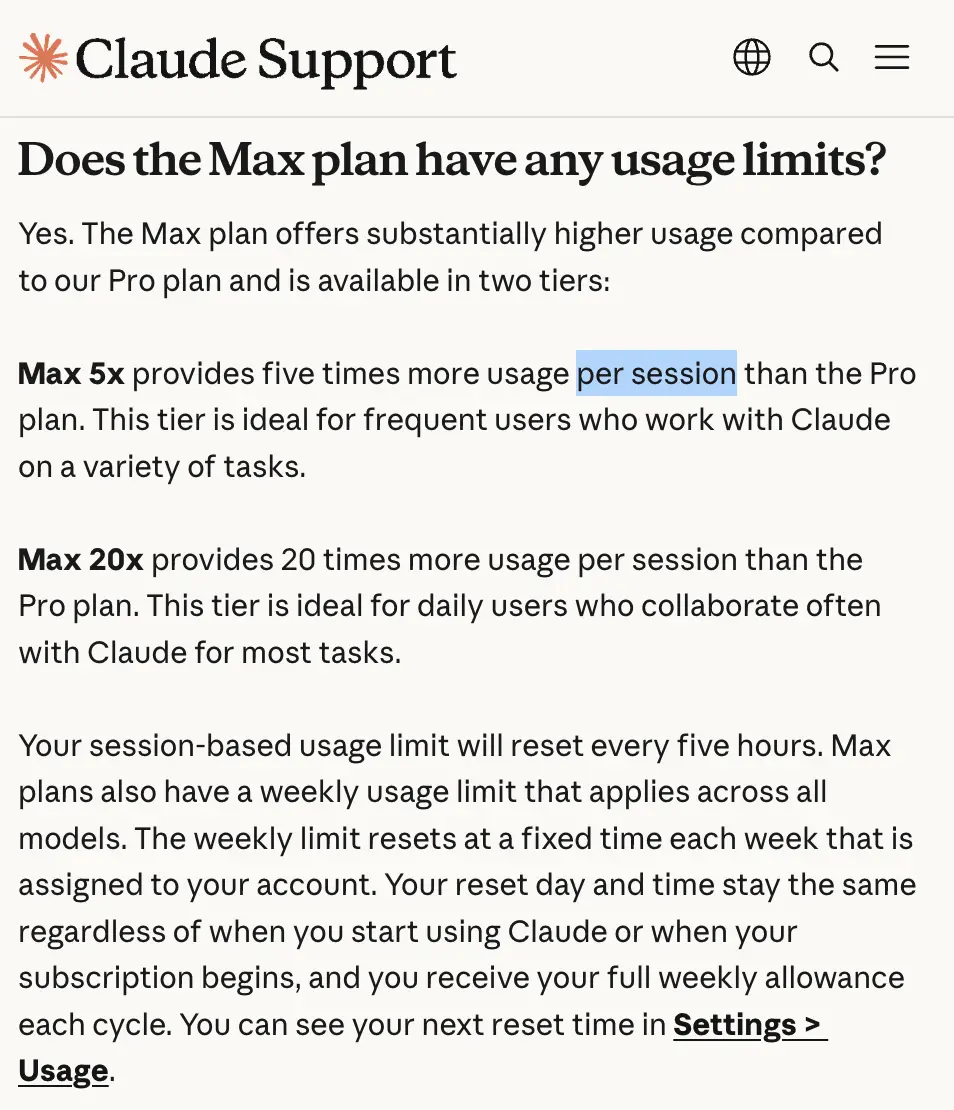
Claude Max 20x multiplies the amount of work you can do inside a single 5 hour window. Anthropic is direct about it: "Max 20x provides 20 times more usage per session than the Pro plan", with the 5x tier described the same way at 5 times.
Does the 20x apply to the weekly limit?
No. The multiplier is attached to the session. The weekly limit is its own cap, applying across all models, and on that page it carries no published figure of any kind: no multiplier, no hours, no messages, no tokens. What a Max plan buys, in the part that is quantified, is a much larger 5 hour window. The shape of your own weekly allowance shows up in Settings then Usage.
What does a 5 hour session window mean?
It means your session allowance runs on a 5 hour cycle rather than on a fixed time of day. It is not tied to midnight or to the top of the hour, so 2 people on the same tier can run out at completely different points in the afternoon. That cycle is the window the 5x and 20x multiply.
When does the weekly limit reset?
On a fixed day and time assigned to your account. This is the detail worth looking up, because it does not follow your billing date: the reset day and time stay the same regardless of when you started using Claude or when your subscription began, and the full weekly allowance arrives each cycle. Your next reset time sits in Settings then Usage.
What do people report their weekly allowance running to?
The weekly cap carries no published figure, so every number in circulation is an estimate rather than a measurement, and each one describes the weekly allowance rather than the session window the 5x and 20x multiply. At the time of writing, estimates put the weekly allowance at roughly 6 to 8 times Pro on Max 20x, and roughly 3.5 times on Max 5x.
Take the direction rather than the decimals. On those estimates the weekly allowance does grow with the tier, on its own scale rather than the session window's. So the tier question is still settled by which wall you meet, and by how far short you fall when you meet it.
Which limit is worth planning around?
I read up on the limits before I upgraded and still met the weekly wall first, rather than the session one. That is the whole argument for watching your own meter rather than reasoning from a plan description: a session multiplier is a real thing to buy, and it is aimed at a constraint you may not be the one hitting.
Claude Pro, Max 5x and Max 20x: Prices and What Each Covers
Prices below are US dollars per month at the time of writing, and Anthropic can change them.
| Plan | Price | What the tier covers |
|---|---|---|
| Pro | $20 monthly, or $17 monthly billed annually | The baseline every multiple is measured against |
| Max 5x | $100 | 5 times Pro usage per 5 hour session |
| Max 20x | $200 | 20 times Pro usage per 5 hour session |
Bottom line: if your work arrives in long concentrated sessions, the session multiplier is the thing you are buying and the higher tier does real work. If your work is spread evenly across the week, the weekly cap is what you will meet, and the multiplier on the plan is not the thing describing it. The estimates above are the only guide to how far that cap moves between tiers.
How Codex Structures the Same Choice
Codex draws the line in a different place, and that difference is the most useful thing available to anyone weighing both.
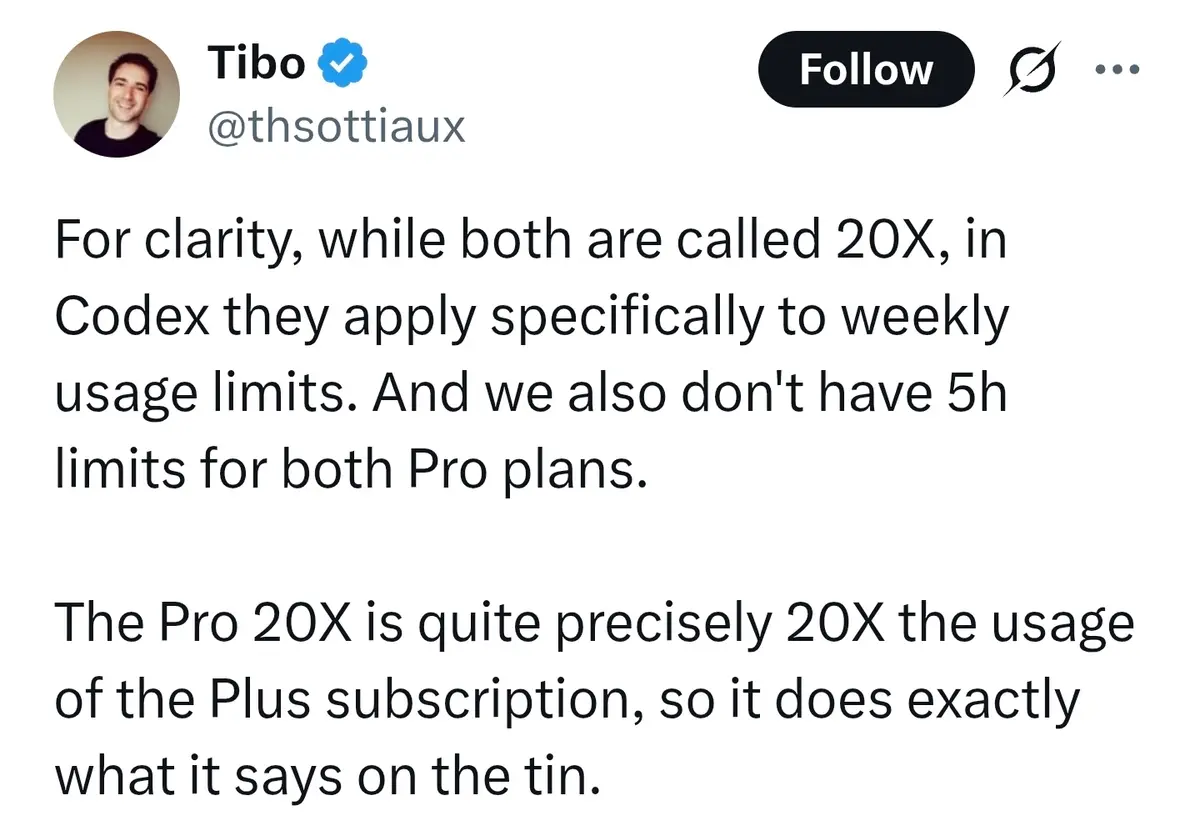
Tibo Sottiaux, who leads Codex at OpenAI, said that "while both are called 20X, in Codex they apply specifically to weekly usage limits. And we also don't have 5h limits for both Pro plans." He added that "the Pro 20X is quite precisely 20X the usage of the Plus subscription".
That is current at the time of writing, and it matters more than it sounds. On Codex Pro the number on the plan describes the limit that constrains sustained work across a week, which is the limit heavy users tend to meet. On Claude the same number describes the session.
Where a 5 hour window does apply, what does it cover?
Local and cloud together. On the plans that do carry one, local messages and cloud chats sit inside a single 5 hour window per OpenAI's pricing documentation, so moving a long job to the cloud to spare your terminal allowance does not buy a separate allowance. My post on Codex usage limits goes deeper into how far a single long run gets you inside that window.
Does either product publish a weekly figure?
Not on the pages linked here. Codex notes that additional weekly limits may apply, and Claude states that Max plans carry one. Neither attaches a number to it, which points at the same conclusion on either product: the figure that describes your account is the one on your own usage screen.
Claude and Codex side by side
| Claude Pro and Max | Codex Plus and Pro | |
|---|---|---|
| What 5x and 20x describe | The 5 hour session window | The weekly limit |
| 5 hour cap | On every tier | Not on the Pro tiers |
| Where your own number lives | Settings then Usage | Your usage page |
Read Your Own Meter Before You Upgrade
Settings then Usage is the one number in this whole subject that belongs to you rather than to a pricing page. It shows what you have consumed and when your next reset lands, and a week of watching it answers the only question that decides the upgrade: which of the 2 limits are you actually hitting.
If you run out inside a long afternoon and then have plenty left the next morning, the session window is your constraint, and a higher Max tier buys exactly that. If you sail through individual sessions and then find yourself stopped on a Thursday with nothing obviously wrong, the weekly cap is your constraint, and a larger session multiplier is aimed somewhere else. Running 2 sessions at once has never given me 2 allowances either.
4 checks before you upgrade
- Find your reset day. Open Settings then Usage and note when the weekly cycle turns over. It is fixed to your account, so it is the same every week.
- Watch a full week. Log where you stop. Session wall, or weekly wall. A week of real data settles the tier question on its own.
- Match the tier to the shape. Concentrated bursts point at the session multiplier and reward the higher Max tier. Steady daily work points at the weekly cap, where the multiplier is not the lever.
- Plan the session before you start it. In my own use, a run that keeps rereading the same large files stops sooner than the same work scoped tightly up front. Cheaper than a tier upgrade, and you find out inside a week.
Frequently Asked Questions
How much does Claude Max cost?
Claude Max is sold in 2 tiers at the time of writing: Max 5x at $100 per month and Max 20x at $200 per month, both in US dollars and before tax. Claude Pro sits below them at $20 monthly, or $17 per month when billed annually. Prices and plans can change, so check the current figure before you commit.
Is Claude Max 20x worth it over Max 5x?
Claude Max 20x is worth the step up when your work concentrates into long unbroken sessions, because that is the window the multiplier expands. If you stop most often at the weekly cap rather than inside a session, the extra $100 is buying session capacity you were not short of. Estimates put the weekly gain between the 2 tiers at roughly double, so weigh that against how far short you actually fall, and a week of usage data will tell you which of those you are before you spend it.
What happens when I hit my Claude weekly limit?
You wait for the reset, which arrives at the fixed day and time assigned to your account rather than on a rolling basis. Because that time does not shift with your billing date or with when you started, it is worth looking up once and planning heavier work around it.
Does a bigger plan give me a bigger context window?
No, and these are 2 different limits that are easy to run together. Usage limits govern how much work you can do in a window, while the context window governs how much the model can hold in a single conversation. Moving up a tier changes the first and not the second.
How do I check my Claude usage?
Open Settings then Usage inside Claude. It shows your current consumption and your next reset time, and it is the only figure specific to your account rather than to a plan description.