
← Back to blog5 min read
Claude Sonnet 5 and Opus 4.8 sit close on paper. Sonnet costs 40% less and lands within about two points of it on most benchmarks, so on the majority of your work you will not feel the difference. Opus still pulls ahead where the coding gets hardest, and there it earns the premium. The real decision is not which model you pick. It is which effort level you run, because that moves your bill more than the model name does. Here is what the benchmarks actually say, where the gap is real, and how to match the model and the effort to the task.
This space moves fast. The prices, models, and numbers here are current at the time of writing, so check the linked sources for the latest.
Key Takeaways
- Sonnet 5 is 40% cheaper than Opus 4.8 per token at standard pricing, $3 and $15 per million tokens versus $5 and $25. At the time of writing, a launch promo dropped it further, to $2 and $10, through August 31, 2026.
- On most benchmarks Sonnet 5 sits within about two points of Opus 4.8. With tools it ties on hard reasoning, and on knowledge work the two are level.
- The one real gap is the hardest coding. On SWE-bench Pro, Opus leads 69.2 to 63.2, about six points.
- Cheaper per token is not always cheaper per task. Higher effort burns more tokens, so the price gap shrinks on the heaviest jobs.
- Reach for Sonnet 5 at low and medium effort, where the gap is narrowest and the savings are biggest. Keep Opus for the top, the hardest coding or maximum accuracy.
What is the difference between Sonnet 5 and Opus 4.8?
Sonnet 5 and Opus 4.8 are two Claude models from Anthropic that sit at different points on the same price and capability curve. Opus 4.8 is the flagship, the most capable and the most expensive. Sonnet 5 is the faster, cheaper model that now scores close to Opus on most public benchmarks while costing 40% less per token. Both let you set an effort level, which controls how much the model thinks, and how many tokens it spends, on a given task.
That last part matters more than it sounds. It means the model is only half the cost decision. The effort level is the other half.
How close is Sonnet 5 to Opus 4.8 on benchmarks?
Close enough that on most work the difference does not show. Here is how the two compare on the current, hard benchmark suites, using Anthropic's own reported numbers.
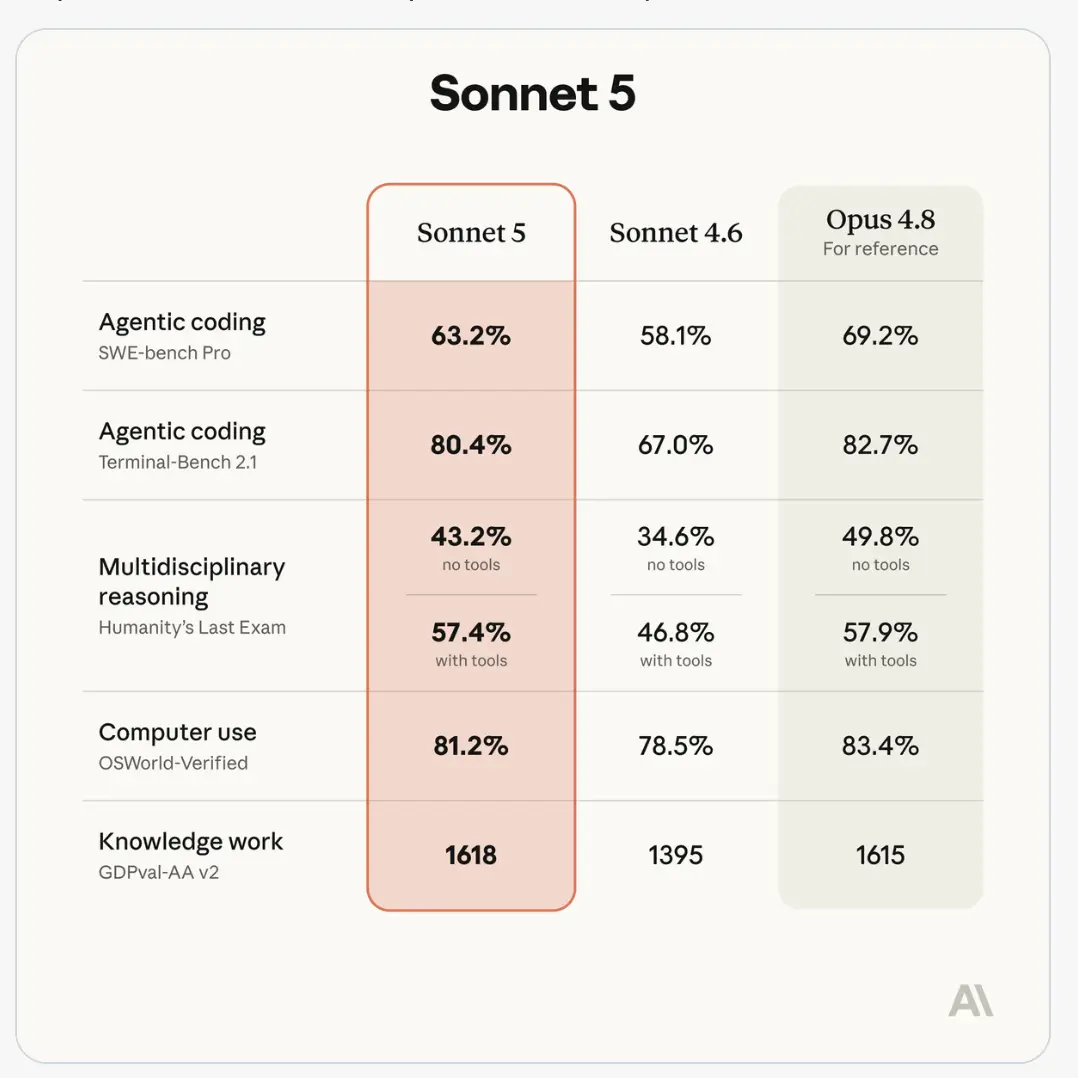
According to Anthropic's own Sonnet 5 announcement, Sonnet 5's performance is close to that of Opus 4.8 at a lower price. The chart above backs that up. On terminal work and computer use it is about two points behind. On hard reasoning, once you give it tools, the gap closes to half a point, which is a tie. On knowledge work the two are level, and GDPval is an Elo style score, so the three point spread there is inside the noise, not a real lead for either side.
So where does the gap open up? One place: the hardest coding. SWE-bench Pro is the messy real world stuff, bug fixes that span many files in a large codebase. Opus leads there by about six points, 69.2 to 63.2. When the work gets that hard, Opus earns its premium.
Cheaper per token is not cheaper per task
Sonnet 5 is 40% cheaper per token at standard pricing, $3 and $15 per million input and output tokens against Opus at $5 and $25. At the time of writing, a launch promo makes the gap wider still, $2 and $10 through August 31, 2026.
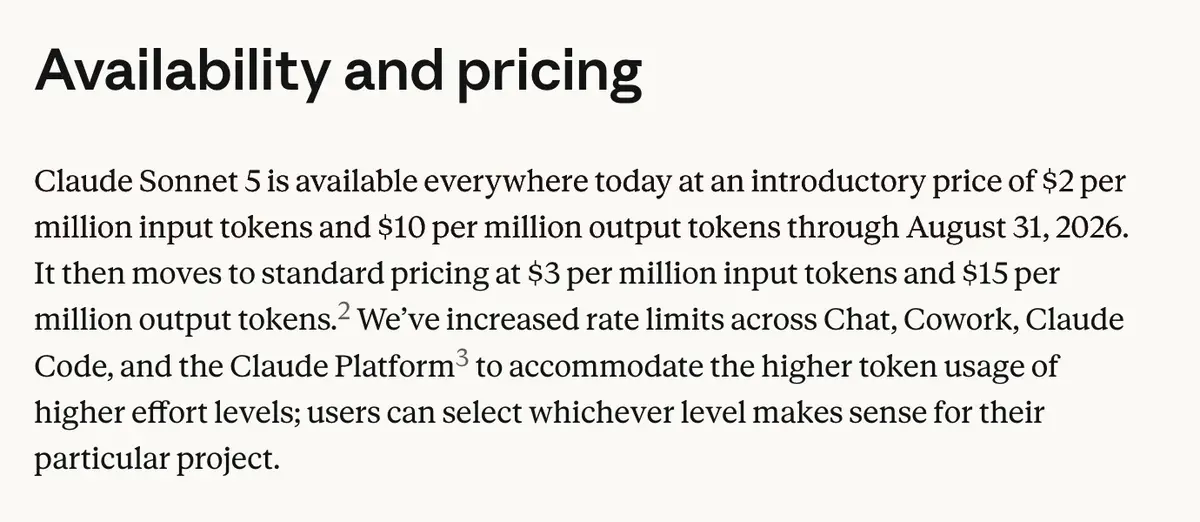
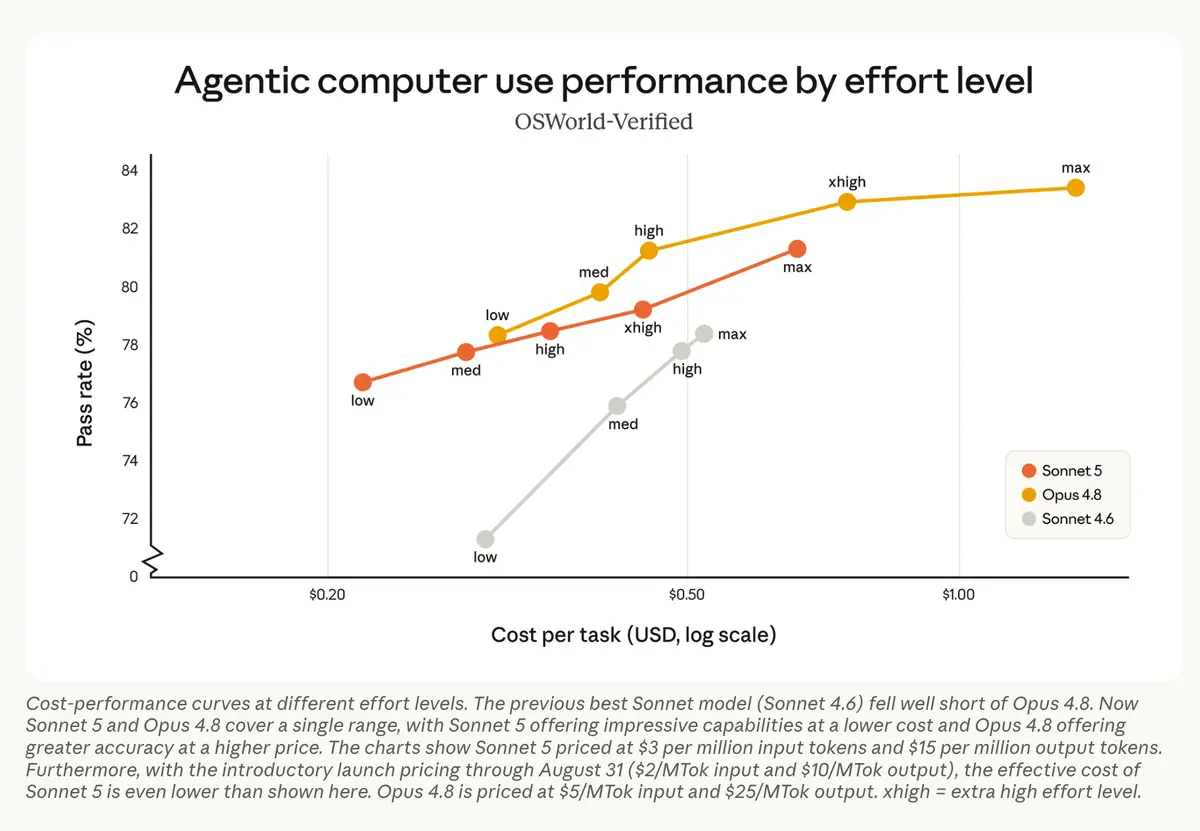
But cheaper per token is not the same as cheaper per task. Each model runs at an effort level, and higher effort means more thinking and more tokens spent before you get an answer. Push Sonnet 5 to a high effort level and it burns more tokens, so the price gap against Opus shrinks on the heaviest tasks.
Anthropic published two cost per task charts, and they tell different stories. On computer use, Sonnet 5 stays cheaper across the whole range while sitting about two points below Opus.
On agentic search the picture flips. At high and extra high effort, Opus leads per dollar. Sonnet 5's advantage there sits at low and medium effort, at a cost per task Opus cannot reach.
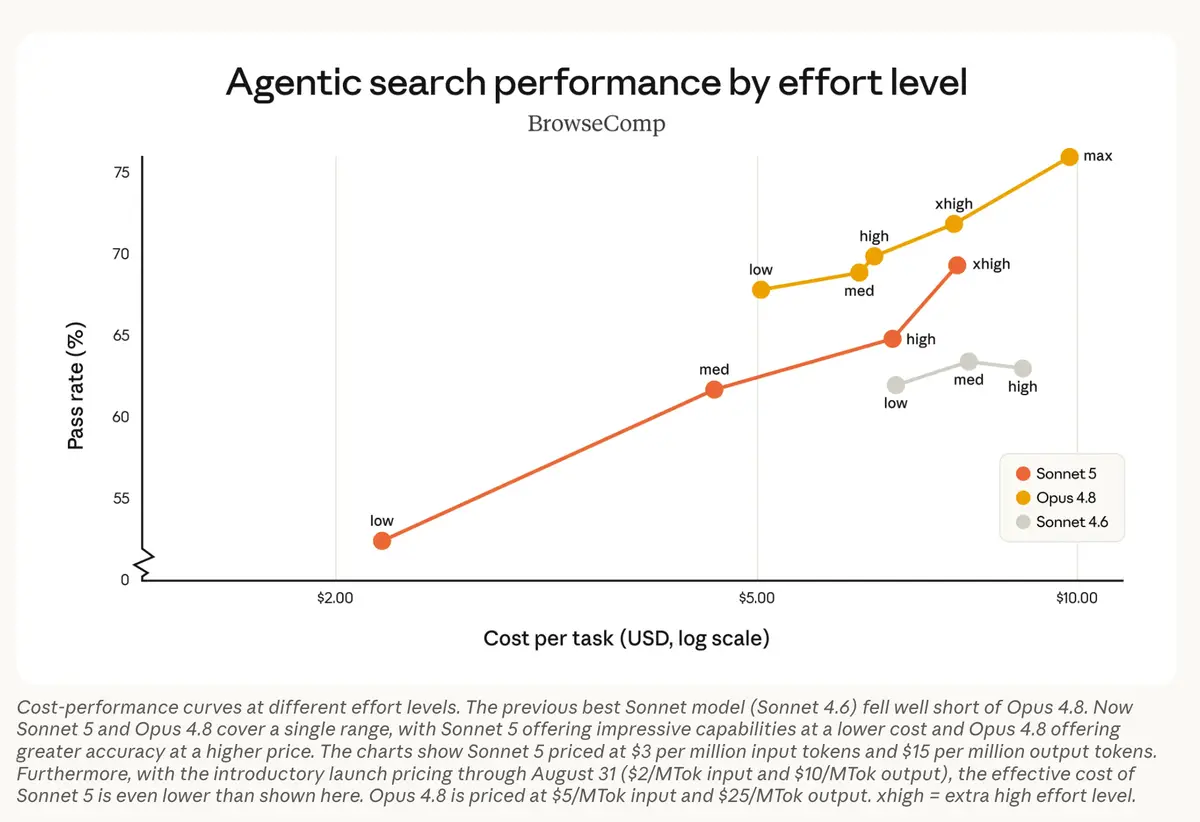
The read across both charts is the same. The savings are real, but they are biggest at lower effort. Push the effort to the top and you are paying closer to Opus prices anyway.
The same arithmetic holds outside the Claude family. When OpenAI cut its own rates, the session cost turned out to matter more than the headline discount, which is worth knowing before you switch models to save money.
When should you use Opus instead of Sonnet 5?
Match the model to the task, not to habit. Here is the rule I use.
- Use Sonnet 5 at low and medium effort. This is where the benchmark gap is narrowest and the price delta is biggest, so it is the best value for the bulk of everyday work.
- Use Opus at the top. For the hardest coding, the changes that span many files in a big codebase, or any task where maximum accuracy is worth the cost, Opus is still the right call. Anthropic also points to Opus 4.8 for cybersecurity work that needs reduced guardrails.
- Watch the effort dial, not just the model. Because effort drives both cost and quality, the level you select often changes your bill more than the model name does. Pick the effort the task actually needs.
In practice, my default is Opus, but only because I run it as an orchestration setup: Opus plans and directs the work, and cheaper models do the volume. For smaller, mechanical tasks I start on Sonnet, and with Sonnet 5 I trust it with more than that now, work I would once have kept on Opus. I keep effort on high and leave it there for the whole session, so the model is the only dial I actually move. And I set that model at the start of a session, not in the middle of one, because switching models makes the new one reread the entire conversation from scratch, which costs time and tokens. Match the model to the work ahead, then let it run.
If you want most of a flagship model's quality while paying less to run it, there is a middle path too. The advisor setup pairs a cheap model that does the work with a stronger one it only consults at the hard calls, so most tokens bill at the cheaper rate.
Frequently Asked Questions
Is Sonnet 5 cheaper than Opus 4.8?
Yes. At standard pricing Sonnet 5 costs $3 per million input tokens and $15 per million output, versus $5 and $25 for Opus 4.8, which is 40% less per token. A launch promo lowered it further, to $2 and $10, through August 31, 2026.
Is Sonnet 5 as good as Opus 4.8?
On most benchmarks it is within about two points, and with tools it ties Opus on hard reasoning. The exception is the hardest coding: on SWE-bench Pro, Opus leads by about six points, 69.2 to 63.2. For most work the difference does not show. On the hardest coding it does.
When should I use Opus instead of Sonnet 5?
Use Opus for the hardest coding, for tasks where maximum accuracy is worth the cost, and, per Anthropic, for cybersecurity work that needs reduced guardrails. For everyday work at low and medium effort, Sonnet 5 gets you most of the way at a lower price.
Does the effort level change the cost more than the model?
Often, yes. A higher effort level makes the model spend more tokens, so a cheaper model at high effort can cost as much as a pricier one at low effort. That is why cheaper per token is not always cheaper per task. Match the effort level to what the task needs. Agent count multiplies the same way, so if you run dynamic workflows, capping the fleet size saves more than the model choice does.
Getting the most out of Claude
The takeaway is not that one model wins. It is that the smart move is matching the model and the effort to the task in front of you, instead of defaulting to the most expensive option for everything. Do that and the same work costs less without getting worse. The same idea holds across brands, not just inside Claude. I put Gemini 3.6 Flash up against Claude and GPT to show which jobs each model actually wins.
One update on the Opus side of this comparison. Claude Opus 5 has since replaced Opus 4.8 at the same price per token, so if you are weighing Sonnet against Opus today, the Opus you get is a stronger one for the same money.
If you want to get more out of Claude Code without overpaying, the AI workshop covers this kind of model and effort matching live, working in Claude Code side by side.