
← Back to blog6 min read
The Claude Code advisor setup pairs a cheap, fast model that does the actual work with a smarter model that only steps in at the hard decisions. Anthropic tested this exact setup on a real coding benchmark and found it recovers most of a flagship model's quality for a fraction of the cost per task. The catch is that Anthropic's own advisor tool only runs on the API, billed per token, off a subscription. This post covers what the benchmark actually measured, why the real tool is out of reach for most subscription plans, and how I rebuilt a close approximation for free inside Claude Code.
Update, July 2026: Anthropic has since built the advisor into Claude Code as an experimental
/advisorcommand you can only run in the terminal, on your subscription with no API account needed (see the docs). Fable is temporarily unavailable as an advisor through it, and the free setup below still works.
Key Takeaways
- Anthropic's SWE-bench Pro test paired a Sonnet 5 executor with a Fable 5 advisor and reached about 92% of Fable 5 solo's score, at about 63% of Fable 5 solo's cost per task.
- The real advisor tool is a server side API beta. It bills per token and is not part of a Pro or Max subscription.
- A free version works inside Claude Code: pin a separate agent file to a stronger model, give it read only access, and have your main session consult it at hard decisions only.
- Fable 5 is not available as an advisor on a subscription right now, because Fable moved to paid usage credits, so Opus stands in. Anthropic did not benchmark that exact pairing, so treat any savings as directional, not identical to the tested numbers.
- The free version falls short of the real tool, mainly because it cannot see your live conversation the way the API version does automatically.
What Is the Claude Code Advisor?
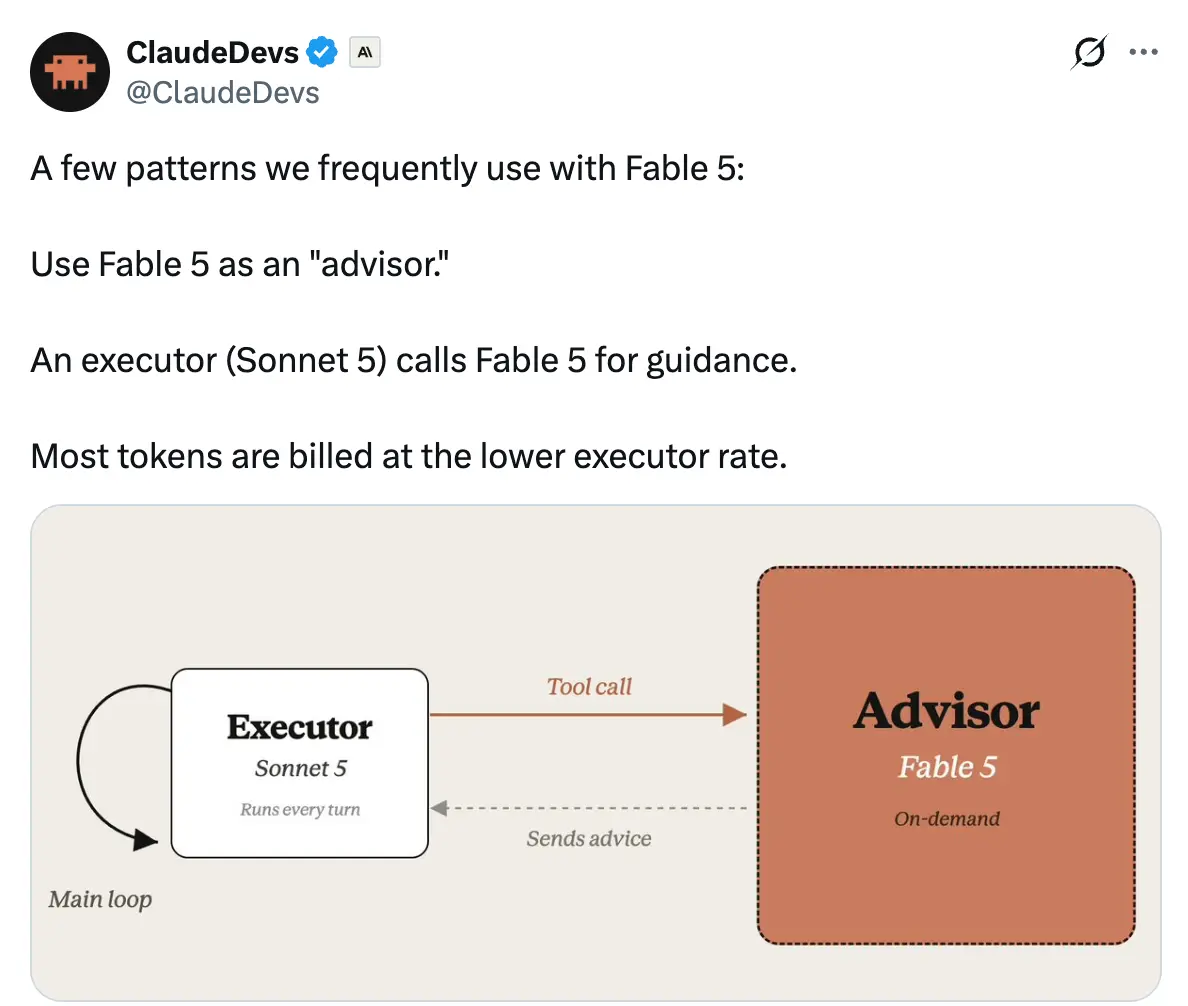
The Claude Code advisor is a setup where a cheaper, faster model does all of the actual work, and a separate, more capable model only gets consulted at the decisions that are genuinely hard to get right. The cheap model, the executor, runs every turn of the session. The advisor sits on the side, on demand, and gets called in with a specific question rather than running the whole task itself. Because the advisor is called rarely, most tokens in a session get billed at the executor's lower rate, not the advisor's higher one.
It is a flip of the usual habit. Most people reach for the expensive model to drive everything. Here the cheap model drives, and the expensive one only advises.
The Benchmark: How Much Does an Advisor Actually Add?
Anthropic ran this setup on SWE-bench Pro, a coding benchmark, and published the results.
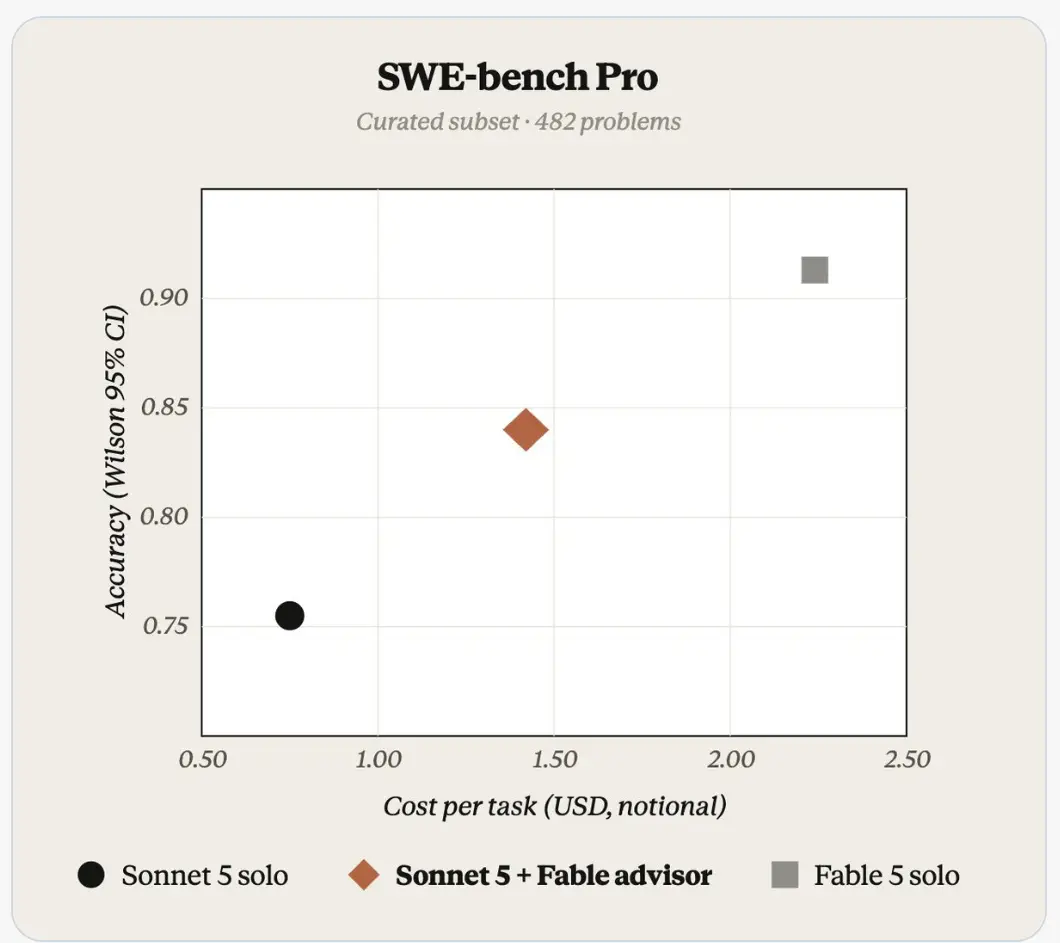
Sonnet 5 working alone scored well behind Fable 5 working alone, the kind of gap that shows up whenever a cheaper model runs solo. Add a Fable 5 advisor to the Sonnet 5 executor, calling it in about once per task to steer the harder calls, and the combination reached about 92% of Fable 5 solo's score, at about 63% of Fable 5 solo's cost per task.
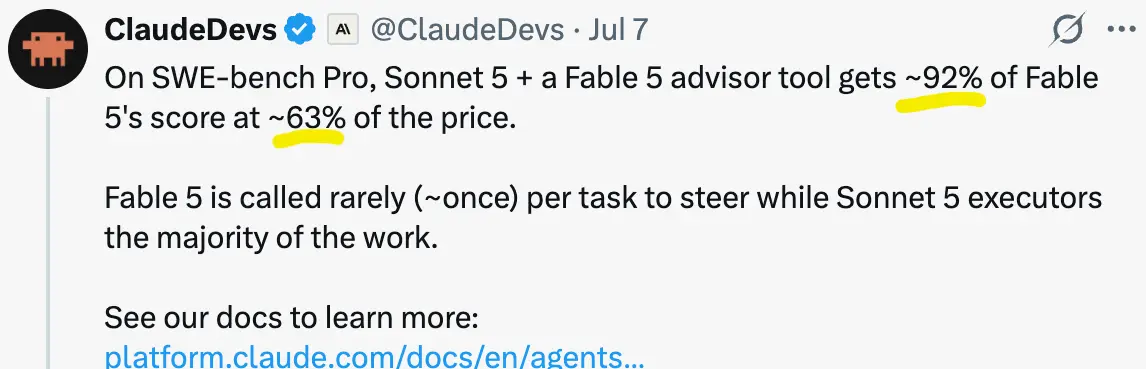
"Fable 5 is called rarely (~once) per task to steer while Sonnet 5 executes the majority of the work," Anthropic's own developer account wrote when it published the results.
This is the specific pairing the benchmark tested: a Sonnet 5 executor with a Fable 5 advisor. It is not a benchmark of Opus as the advisor, which matters for the setup most people actually end up running, covered below.
The Catch: Why the Real Advisor Tool Is Off Your Subscription
The tool that produced those numbers is not a plan feature. It is a server side API beta, billed per token, sitting outside the Pro and Max subscription plans. A subscription cannot turn it on, and most people are not going to open a separate, metered API account just to test one workflow. The mechanism is documented in Anthropic's advisor tool reference for anyone who wants the full picture. The benchmark is real and the mechanism is real, but the exact tool that ran it is not something a subscription plan includes.
The part that makes the real tool work is worth naming, because it is also the part I could not reproduce. On the API, the server automatically hands the advisor the executor's entire transcript mid task: the system prompt, the tools, every prior turn, and the text produced so far. The advisor sees the whole situation without being told any of it, then hands back a plan or a course correction. That automatic handoff is the magic, and it lives only on the API.
How to Set Up a Free Advisor in Claude Code
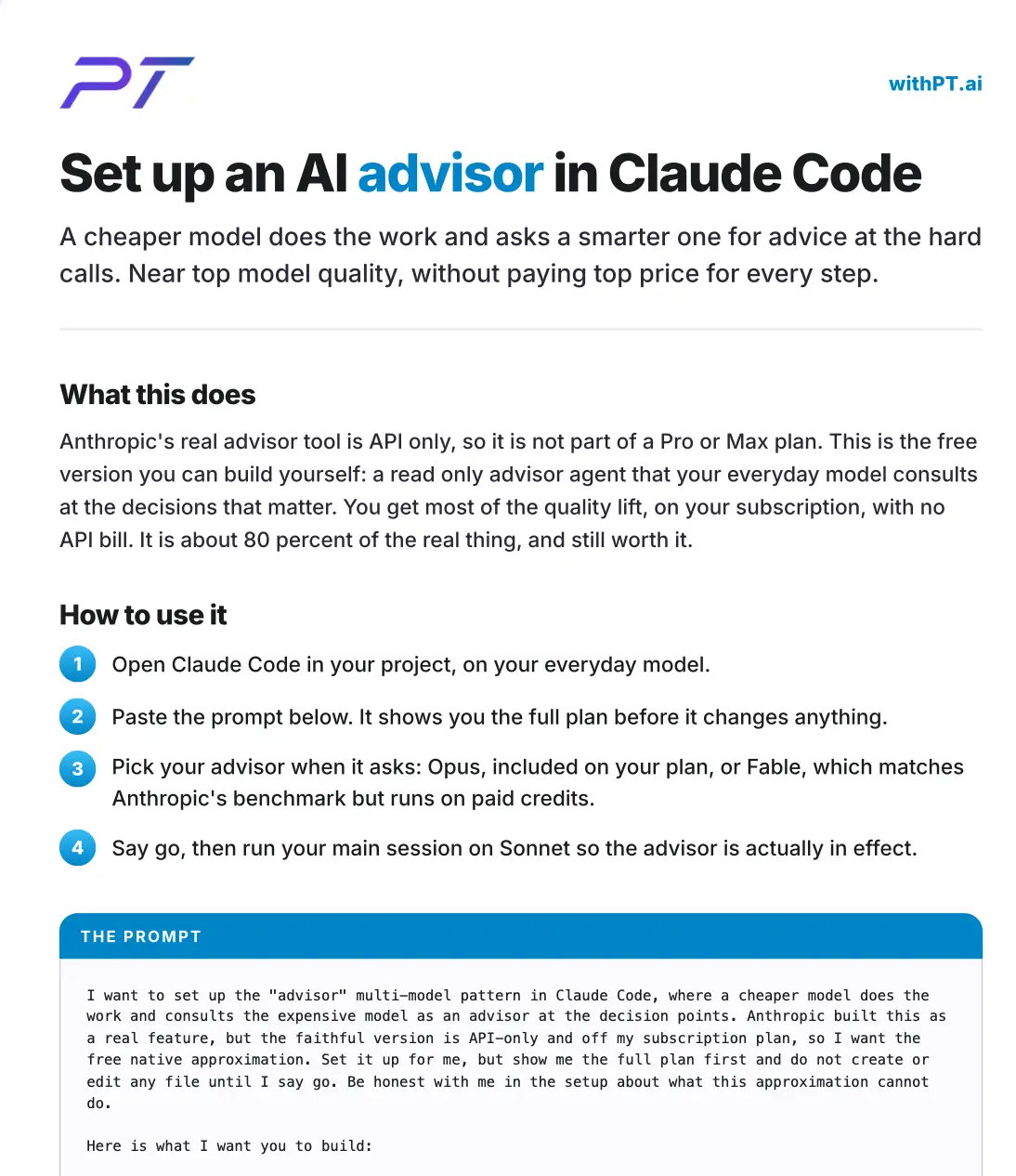
You can rebuild most of it for free, on your existing subscription. The whole setup is one prompt and one agent file. Here is exactly how I do it.
- Open Claude Code with your project open. Start on your everyday model.
- Paste the setup prompt. It shows you the full plan before it creates or edits a single file, and it waits for you to approve.
- Pick the advisor tier when it asks. Use Opus. Anthropic ran the benchmark with Fable as the advisor, but Fable is not available as an advisor on a subscription right now, so Opus is the one to pin.
- Say go. It writes an advisor agent file with read only access, so the advisor can read your code but never edit it, and it adds a short policy to your CLAUDE.md telling your main session to consult the advisor before any hard decision.
- Run your main session on Sonnet. That last step is what puts the setup in effect. The cheap model does the work, and it asks the advisor when a call is hard.
Once it is in place, the shape of the session looks like this: a main loop running the executor model calls the advisor with a tool call when it hits a hard decision, and the advisor reads what it needs, then sends its answer back without ever taking over.
Why I Reach for Sonnet Near My Limit
This one really comes in handy when I am close to my usage limit on my Max plan. Instead of running the session on Opus, I start it on Sonnet and let it call the advisor when a decision is hard. Sonnet spends fewer tokens, so the same budget carries me deeper into the session, and the advisor keeps the harder calls from slipping. I started leaning on it this way recently, and it is the part of the setup I use most. The same trade shows up on Codex usage limits too.
Along the same lines, I reach for the orchestration model more often now, where a planning model maps out the work and cheaper models carry it out. Same idea as the advisor: keep the expensive model on the calls that need it, and let the cheaper one do the volume, which is also what sizes a dynamic workflow's agent fleet.
How Close Is the Free Version to the Real Thing?
The setup above is not the tool Anthropic benchmarked. It is a native approximation, and the whole gap comes down to that one mechanism: the real advisor tool automatically feeds the advisor your entire conversation. A native subagent in Claude Code does not inherit your conversation at all. It only sees the problem statement you hand it, plus whatever it reads from the repository itself. So the quality of the advice is capped by how well you write that problem statement.
In my own testing, that free version gets you about 80% of the way to the real tool. It is not the real thing, but it still catches a wrong approach before you commit to it, which is where most of the value sits. Fresh judgment from a stronger model, at the exact moment a decision is being made, on a subscription budget.
There is also a model choice to make. Anthropic's benchmark used Fable 5 as the advisor, but Fable is not available as an advisor on a subscription right now, so I pin the advisor agent to Opus instead. Opus was not the model in the tested benchmark, so treat any savings from an Opus advisor as directional, in the same range as the tested numbers, not a guaranteed match to them.
Frequently Asked Questions
What is the Claude Code advisor?
It is a setup where a cheap model does the actual work and a smarter model only gets consulted at the hard decisions, instead of running every step itself. Most tokens in the session get billed at the cheaper model's rate.
Can I use the real Anthropic advisor tool on a Claude subscription?
No. The real advisor tool is a server side API beta, billed per token, and is not part of a Pro or Max subscription. You can rebuild most of the behavior for free with a pinned agent file instead.
Is a free advisor setup as good as the real tool?
Not quite. The gap is mostly about context. The real tool automatically feeds the advisor your full conversation, and a native subagent does not, so it has less to work with. In my testing it still closes most of the gap and is worth running on a subscription budget.
Which model should I use as the advisor?
Opus. Anthropic ran the benchmark with Fable as the advisor, but Fable is not available as an advisor on a subscription right now, so Opus is the practical choice. Its results are directional, close to the tested numbers, not an exact match.
Does the advisor slow down every response?
No. The advisor is only called at hard decisions, not on every turn, so most of the session runs at the cheaper executor model's speed and price.
Getting More Out of This
The advisor setup is not a trick. It is a real architecture Anthropic tested and published numbers for. The free version inside Claude Code will not match the exact API benchmark, but it keeps the core idea intact: stop paying flagship prices for every keystroke, and only bring in the expensive model when a decision actually calls for it.
If you want to go further with multi model workflows like this one, the workshop covers this kind of setup live, along with the delegation setup that pairs with it.