
← Back to blog4 min read
Claude Fable moves to paid usage credits. It is not being deleted, it moves from your Claude plan to costing money per interaction. Before you lose easy access, run three prompts to save what Fable already knows about your work: a handoff brief, a blind spot check, and a permanent reference document. The same move works for any AI model you will eventually lose cheap access to. The model is temporary. The documents you build with it are permanent.
This space moves fast. The dates and plan details here are current at the time of writing, so check the linked sources for the latest.
Key Takeaways
- Fable is not being disabled. At the time of writing, Anthropic includes Fable 5 for up to 50% of weekly usage limits through July 7, 2026, after which it runs on paid usage credits.
- Once it draws from usage credits instead of your plan, everyday use costs money per interaction, so it is worth capturing what it knows first.
- Run three prompts before the cutoff: a handoff brief, a blind spot check, and a permanent reference asset.
- Keep Fable for high level thinking and strategy, and let a model like Sonnet or Opus handle the tactical build from the brief it writes.
- The rule generalizes. When you are about to lose cheap access to any model, turn the conversation into artifacts you keep.
What is changing with Claude Fable?
Fable 5 is one of Anthropic's Claude models, and it has been included in Claude subscription plans up to a share of your weekly usage. According to Anthropic's announcement, at the time of writing Fable 5 is included for up to 50% of weekly usage limits through July 7, 2026, after which it becomes available through usage credits. Anthropic has since adjusted these details, so check its current terms for the latest inclusion window and which plans keep Fable.
So this is not the end of the model. It is the end of using it freely inside your plan. It keeps working. You just pay per use through credits after that, which is why capturing what it knows now, while it is still cheap to run, is worth the ten minutes it takes.
Why capture what a model knows before it gets expensive?
When a model has been your thinking partner on a project, the value is not the chat history. It is the context it is holding: the decisions you made, the reasons behind them, the dead ends you already ruled out. The moment that model gets metered, you will reach for it less, and that context starts to fade with it.
The fix is to pull the knowledge out of the conversation and into files you own. A model comes and goes. A document you wrote with it stays, and the next model can read it on day one.
The 3 prompts to run before Claude Fable moves to usage credits
Open Fable with your project in front of it and run these three, in order. Each one turns part of the conversation into something permanent.
1. Write your handoff brief
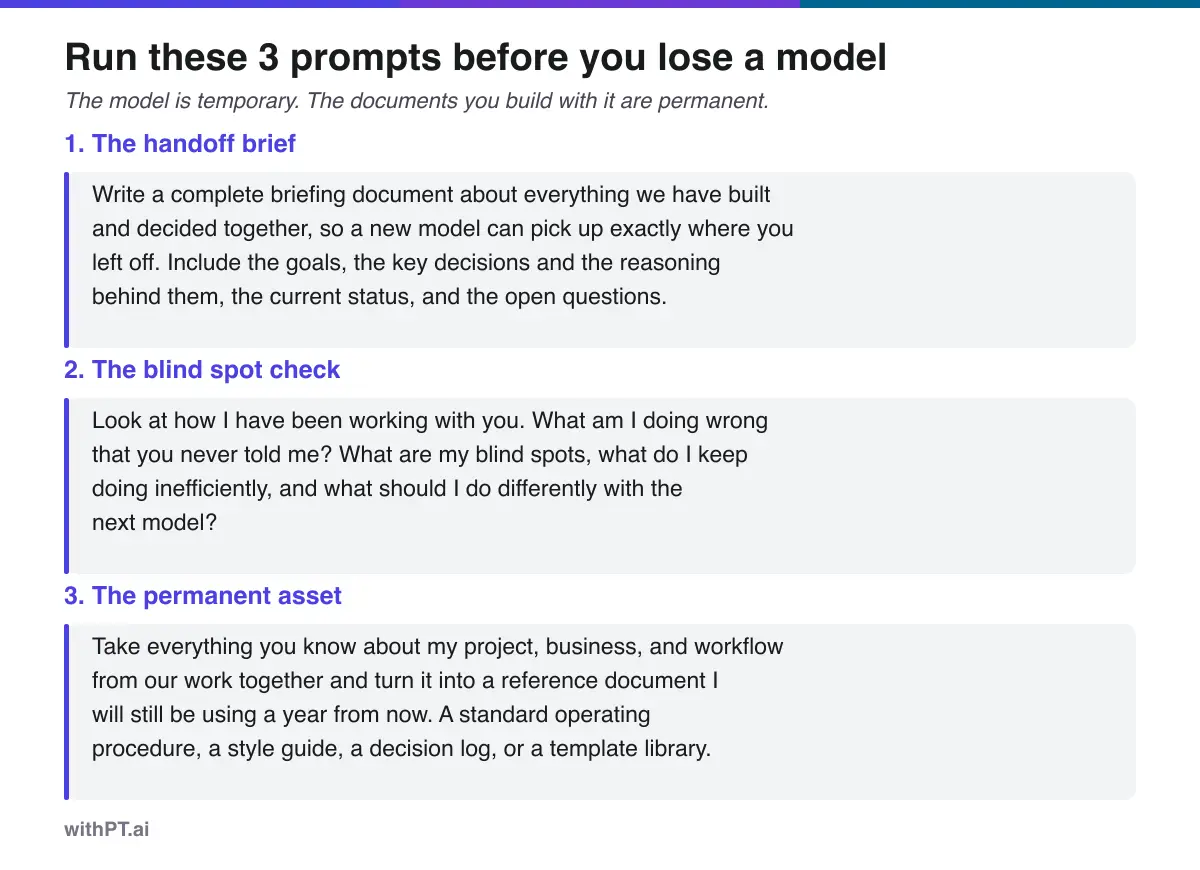
Write a complete briefing document about everything we have built and decided together, so a new model can pick up exactly where you left off. Include the goals, the key decisions and the reasoning behind them, the current status, and the open questions.
This is the document that lets any future model start where this one stopped, instead of you re explaining the project from scratch.
2. Ask for your blind spots
Look at how I have been working with you. What am I doing wrong that you never told me? What are my blind spots, what do I keep doing inefficiently, and what should I do differently with the next model?
You ask AI to critique your work all the time. You rarely ask it to critique you. That answer is the one worth keeping.
3. Turn what it knows into a permanent asset
Take everything you know about my project, business, and workflow from our work together and turn it into a reference document I will still be using a year from now. A standard operating procedure, a style guide, a decision log, or a template library.
This is the asset that outlives the model entirely: a reference you keep using long after you have switched to something else.
After the handoff: which model does what
Once you have the brief, split the work by what each model is good at. Keep Fable for the high level thinking and strategy, and let a model like Sonnet or Opus build from the brief it writes. If you want the honest read on when to reach for which builder, and what it costs, see Sonnet 5 or Opus. And if you are working out whether Fable is still worth paying credits for, Claude Opus 5 now beats Fable 5 on 8 of 12 benchmarks at half the cost per task, which changes that answer for most work.
Frequently Asked Questions
Is Claude Fable being discontinued?
No. Anthropic includes Fable 5 for up to 50% of weekly usage limits through July 7, 2026, after which it is available through usage credits. The model keeps working. What ends is the included, no extra cost access inside your plan.
What does "moves to usage credits" mean?
After the included allowance, Fable draws from paid usage credits instead of your plan, so routine use costs money per interaction rather than being covered by your subscription.
What should I do before Fable moves to credits?
Run three prompts while it is still cheap to run: a handoff brief, a blind spot check, and a request to turn what it knows into a permanent reference document. That way the knowledge lives in files you own, not in a model you will use less once it is metered.
Can I still use Fable after July 7, 2026?
Yes, through usage credits. The three prompts just make sure the important context is saved into your own documents, so you are not paying to re derive what the model already knew.
Getting more out of any AI model
The lesson is bigger than one model. Every model you work with is temporary, and the artifacts you build with it are permanent. Get in the habit of ending a stretch of work by converting the conversation into a brief, a critique, and a reference you keep.
If you want to get more real work out of AI, not just better chats, the AI workshop covers how to delegate to it and build systems you keep, working side by side.