
← Back to blog4 min read
The AI job search agent is a free, open source repo you point Claude Code at, and it runs your whole job search. It finds jobs that match your profile, tailors your resume and cover letter, sends a second AI to critique the draft, and checks the result against the applicant tracking software that scans resumes, so you stop getting filtered out before a human reads it. It even preps you for interviews and tracks your outcomes. It does not apply for you. It builds the full application and hands it to you to review and send.
This space moves fast. The details here are current at the time of writing, so check the repo for the latest.
Key Takeaways
- It is a free, open source project (MIT licensed) with 14k+ stars, built on Claude Code and not made by Anthropic.
- Point Claude Code at the repo and its apply command searches jobs, evaluates fit, and drafts a tailored resume and cover letter.
- A second Claude agent with a fresh context reviews the draft like a tough hiring manager, catching missed keywords and weak lines the first pass left in.
- It checks the resume against an applicant tracking system on the compiled PDF's text layer, the way a parser reads it, so you are not filtered out before a person sees it.
- It does not submit applications. It builds the full application and hands it to you to review and send.
What is the AI job search agent?
The AI job search agent is an open source project, the ai-job-search repo, that turns Claude Code into an end to end job search assistant, built around the same scoped-job discipline I write about for AI agents: one narrow job, checked before it goes out. It is free and MIT licensed, has 14k+ stars, and runs on Claude Code, though it is an independent project and not made by or endorsed by Anthropic. Most people paste their resume into a general chatbot and hope. This does the whole thing properly instead: you hand the repo to Claude Code, and it gets to work.
How the AI job search agent works
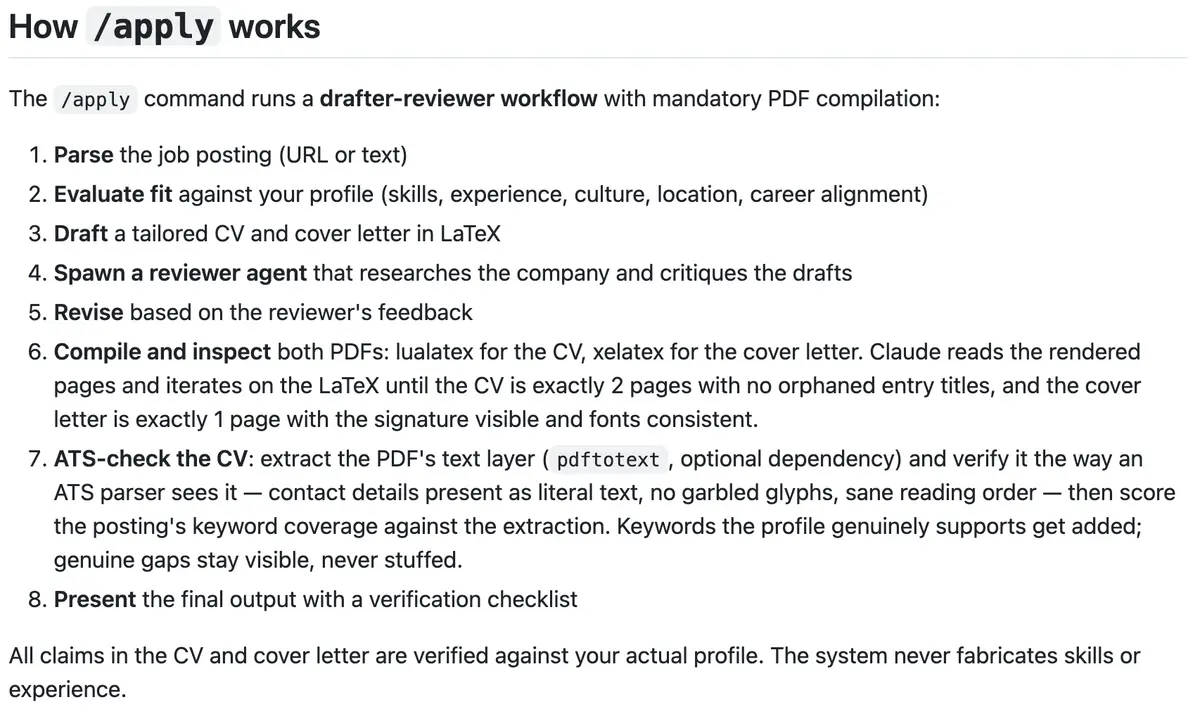
The core is the apply command, which runs one AI to write and a second AI to check its work. Here is the sequence it follows for a single posting.
- Search and match. It finds jobs that fit your profile.
- Evaluate fit. It scores the posting against your skills, experience, location, and career direction before writing anything.
- Draft the application. It tailors a resume and cover letter to the exact job, scoring each line by relevance and cutting the filler.
- Review it with a second AI. A separate Claude agent with a fresh context researches the company and critiques the draft, catching missed keywords, weak lines, and generic filler the first pass left in.
- Revise. The first agent rewrites based on that critique.
- Compile and inspect the PDFs. It builds the resume and cover letter and reads the rendered pages, fixing layout until the resume is exactly two pages and the cover letter one.
- Run the ATS check. It extracts the compiled PDF's text layer and verifies your contact details, the reading order, and the posting's keyword coverage, the way a parser reads it.
- Hand it to you. It presents the finished application with a verification checklist for you to review and send.
What makes it different
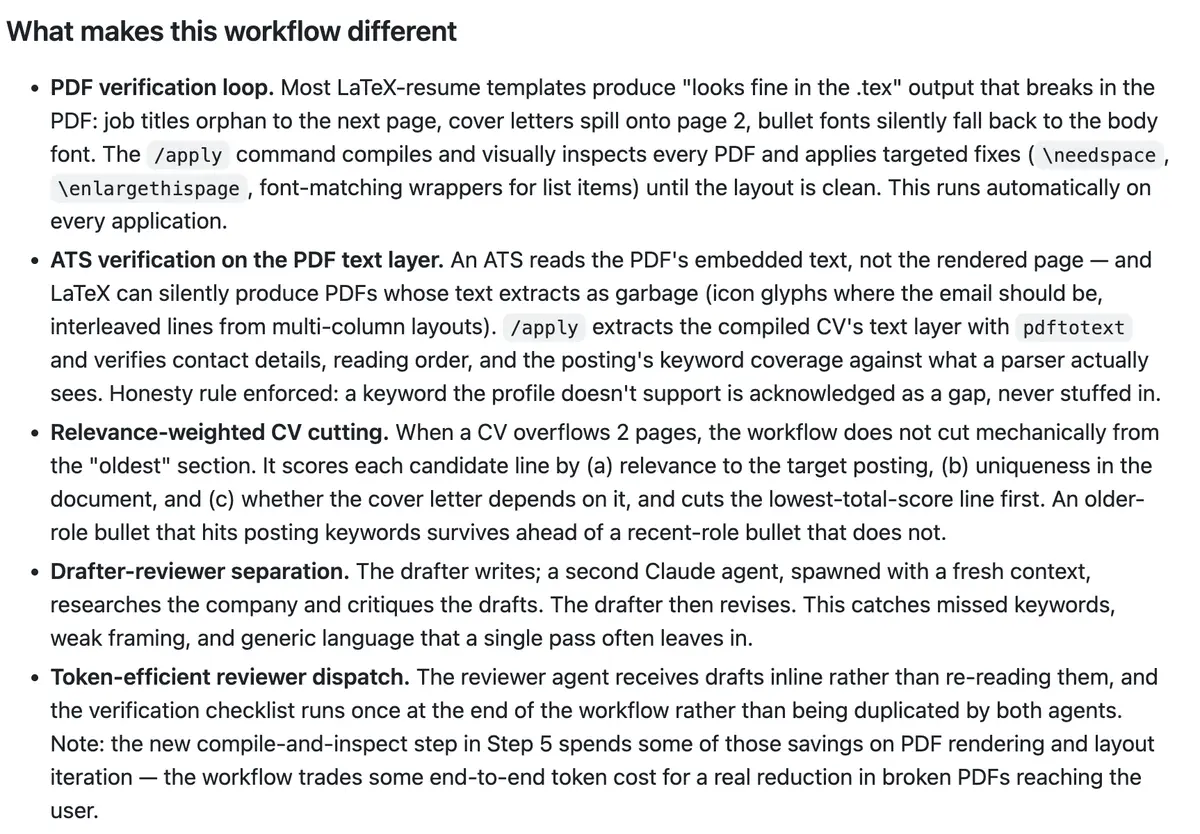
Plenty of tools write a resume. The thing that sets this one apart is the second pass.
- One AI writes, a second one critiques. The reviewer is a separate agent with its own fresh context, so it reads the draft cold, the way a tough hiring manager would. That is how your resume stops sounding like every other AI wrote it. It is the same split behind the free advisor setup I run in Claude Code, just applied to review instead of cost.
- A real ATS check on the PDF text layer. A resume that looks fine can still extract as garbage for the software that parses it. This pulls the text out of the compiled PDF and checks it the way the parser sees it.
- It never invents skills. A keyword your profile does not support is flagged as a gap, not stuffed in. Every claim is verified against your actual profile.
- Relevance weighted cutting. When a resume runs long, it scores each line by relevance and cuts the weakest first, instead of trimming at random.
Beyond the resume
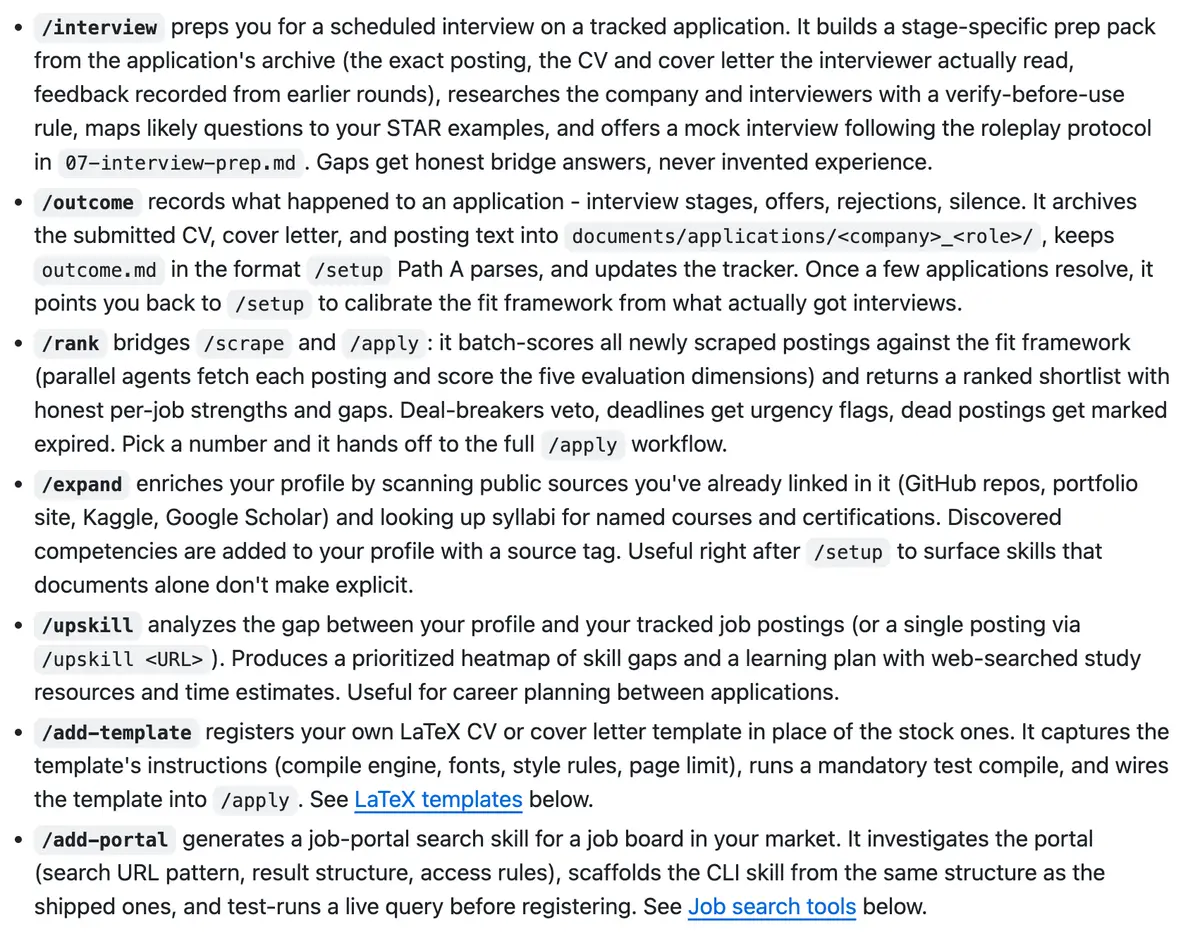
The apply command is the core, but the repo keeps going after the application is built. It also gives you a set of commands for the rest of the search.
- Interview prep. It builds a stage specific prep pack, researches the company, and runs a mock session.
- Outcome tracking. It records what happened to each application and archives the resume, cover letter, and posting.
- Ranking. It batch scores newly found postings and returns a shortlist, flagging deal breakers and deadlines.
- Profile expansion. It enriches your profile from your public sources.
- Upskilling. It maps the gap between your profile and the jobs you are tracking, then suggests what to learn to close it.
What you need to run it
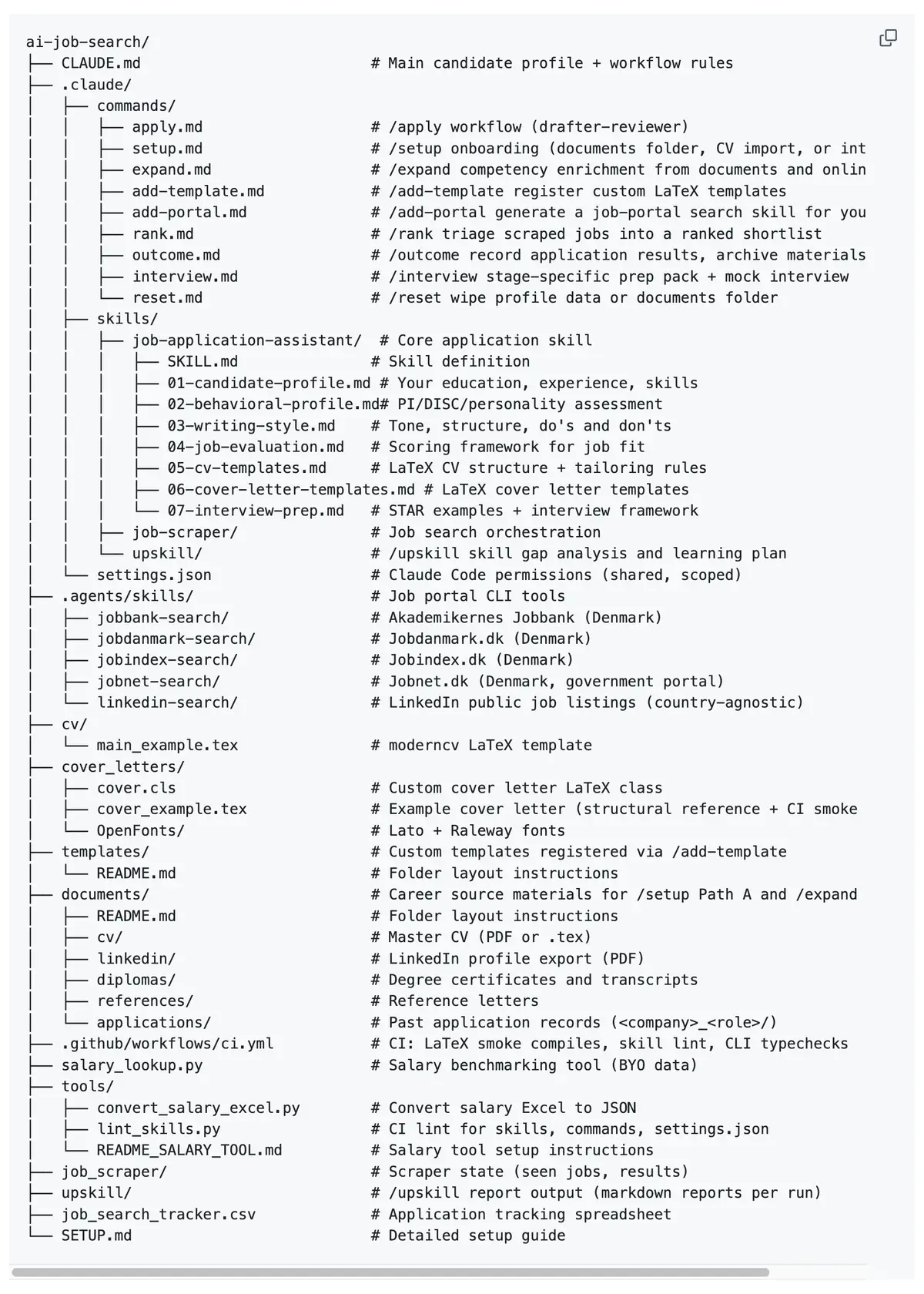
Because you already use Claude Code, driving the workflow is the easy part (if you are still on the defaults, the settings worth changing first are a good place to start). The one time setup is the document tooling. A compiled PDF resume needs a LaTeX install, with lualatex and xelatex. The ATS text check can also use poppler to read the PDF's text, but that one is optional and the check degrades gracefully without it. Set up LaTeX once and the Claude side does the rest.
The included job boards are Danish, plus a country agnostic search that works anywhere. The core workflow, from profile to fit to resume to review to interview prep, is language and country agnostic, and you can register your own local job boards with the add portal command.
Frequently Asked Questions
Is the AI job search agent free?
Yes. It is an open source project, MIT licensed, with 14k+ stars. You run it on Claude Code, so the only cost is your existing Claude usage plus a one time install of the document tooling.
Does it apply to jobs for me?
No. It builds the full tailored application, the fit evaluation, the resume, the cover letter, the second agent review, the compiled PDFs, and the ATS check, and presents it with a verification checklist. You review it and send it yourself.
Is it made by Anthropic?
No. It is an independent open source project built on Claude Code. The project states plainly that it is not affiliated with or endorsed by Anthropic.
What do I need to run it?
Claude Code, plus a one time install of LaTeX for the PDF resume. Poppler is optional; the ATS text check uses it if present and degrades gracefully without it. Once LaTeX is set up, you point Claude Code at the repo and it handles the rest.
Does it work outside Denmark?
Yes. The core workflow is country agnostic. The included job boards are Danish plus a country agnostic search, and you can add your own local boards with the add portal command.
Getting started
If you already use Claude Code, this is worth an afternoon. Point Claude Code at the ai-job-search repo, run the setup, and let it build your first tailored application for you to review. Two AIs, one writing and one critiquing, is the part that makes the output stop reading like every other AI generated resume.
If you want to build tools like this yourself, the AI workshop covers how to turn Claude Code into systems that do real work, side by side.